A Dog Age Calculator is an online tool that estimates a dog’s age in human years using modern scientific aging models rather than the outdated “1 dog year = 7 human years” rule. It considers that dogs mature rapidly during their first few years of life and then age at different rates depending on factors such as breed and size.
Purpose of a Dog Age Calculator
The primary purpose of a dog age calculator is to convert a dog’s actual age into its approximate human-age equivalent. This helps pet owners better understand their dog’s life stage and make informed decisions about nutrition, exercise, preventive care, and routine veterinary checkups.
Many modern calculators also use updated veterinary research to provide more realistic age estimates than traditional conversion methods.
Who Should Use a Dog Age Calculator?
A dog age calculator is useful for:
- Dog owners who want to know their pet’s human-equivalent age.
- New pet parents estimating a rescued dog’s age.
- Breeders monitoring canine development.
- Veterinary professionals as a quick educational reference.
- Anyone comparing dog life stages with human aging.
Why Knowing Your Dog’s Human-Equivalent Age Matters
Understanding your dog’s equivalent human age provides valuable insight into its physical and developmental stage. It can help you:
- Identify whether your dog is a puppy, adult, mature, or senior.
- Choose age-appropriate food and nutrition.
- Plan suitable exercise routines.
- Schedule preventive health screenings.
- Recognize age-related behavioral and health changes earlier.
While a dog age calculator provides an estimate rather than an exact biological age, it offers a far more accurate understanding of canine aging than older calculation methods.
Summary
A dog age calculator estimates a dog’s age in human years using modern aging research instead of the traditional 7-year rule. It helps owners understand their dog’s life stage, support better health decisions, and provide age-appropriate care throughout every stage of life.
Key Points
- A dog age calculator converts dog years into estimated human years.
- Modern calculators are more accurate than the traditional 7-year rule.
- Breed and body size can influence age calculations.
- The tool helps identify a dog’s life stage for better care and health planning.
- Dog owners, breeders, and veterinary professionals can all benefit from using a dog age calculator.
Want to learn more about This content Visit : Dog Heat Cycle Calculator
How Does a Dog Age Calculator Work?
A dog age calculator estimates a dog’s age in human years using modern veterinary research instead of applying a fixed conversion rate. Most calculators recognize that dogs mature rapidly during their first two years and then age at a slower, non-linear pace. The result is a more realistic estimate of a dog’s biological age.
Why Dogs Don’t Age at a Constant Rate
Dogs do not age evenly throughout their lives. Puppies experience rapid physical and developmental growth in their early months, while adult dogs age more gradually. The aging process also varies based on breed size, genetics, overall health, and lifestyle.
Because of these differences, the same number of dog years can represent different human-equivalent ages at different stages of a dog’s life.
Why the 7-Year Rule Is Outdated
The traditional belief that one dog year equals seven human years is an oversimplification. Modern studies show that dogs age much faster during their early years and more slowly afterward. As a result, the 7-year rule often underestimates the age of young dogs and overestimates the age of older dogs.
Today’s dog age calculators use updated aging models that provide more accurate estimates based on current veterinary knowledge.
What Factors Can Affect the Results?
Although most dog age calculators provide reliable estimates, several factors can influence the outcome, including:
- Breed size (small, medium, large, or giant)
- Genetic background
- Overall health and medical history
- Diet and nutrition
- Exercise and activity level
- Weight and body condition
- Preventive veterinary care
These factors affect how quickly a dog ages and its overall life expectancy.
Summary
A dog age calculator uses modern scientific models to estimate a dog’s age in human years. Unlike the outdated 7-year rule, it considers that dogs age rapidly early in life and more gradually as they mature, while factors such as breed size and health can also influence the results.
Key Points
- Modern dog age calculators use updated veterinary research.
- Dogs age faster during their early years than later in life.
- The 7-year rule is no longer considered an accurate conversion method.
- Breed size, genetics, health, and lifestyle all affect canine aging.
- Dog age calculators provide estimates rather than exact biological ages.
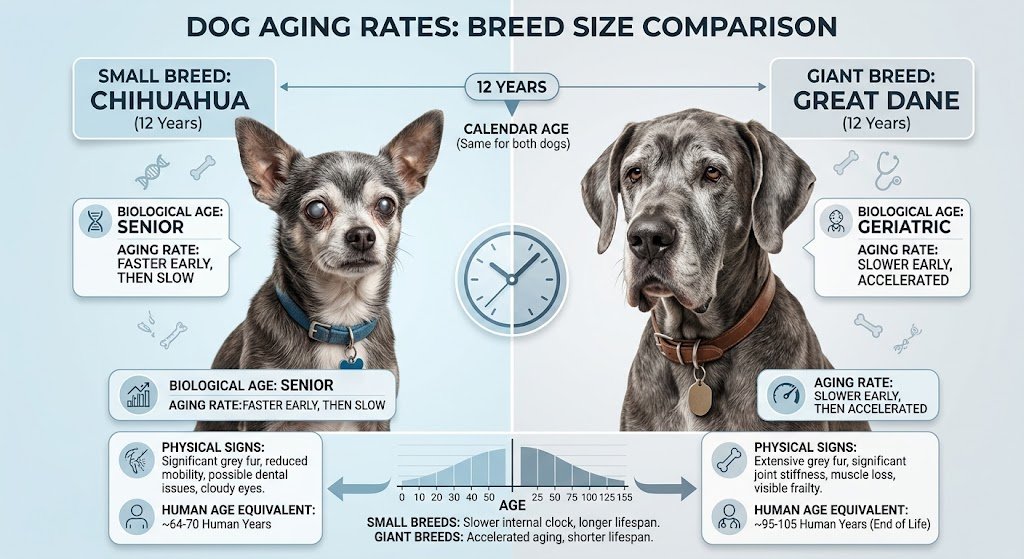
Dog Age Calculator Formula
Modern Dog Age Formula
Most modern dog age calculators use scientifically based aging models instead of a fixed conversion ratio. One widely recognized formula, developed from canine aging research, estimates human-equivalent age as:
Human Age = 16 × ln(Dog Age) + 31
In this formula, ln represents the natural logarithm, which reflects the fact that dogs age rapidly in their early years and more gradually as they get older. This approach provides a more realistic estimate than traditional methods, particularly for adult dogs.
Traditional 7-Year Formula
The traditional method assumes:
Human Age = Dog Age × 7
Although this formula is simple and easy to remember, it does not account for the rapid development that occurs during a dog’s first two years or the different aging rates among breeds. As a result, it is no longer considered an accurate way to estimate a dog’s human-equivalent age.
Which Formula Is More Accurate?
Modern veterinary guidance favors updated age calculation models because they better reflect how dogs actually mature. While no formula can determine a dog’s exact biological age, modern calculators generally provide more reliable estimates than the 7-year rule.
When Should You Use a Dog Age Calculator?
A dog age calculator is useful when you want to:
- Estimate your dog’s age in human years.
- Understand your dog’s current life stage.
- Plan age-appropriate nutrition and exercise.
- Monitor age-related health changes.
- Compare your dog’s age using modern calculation methods.
Formula Comparison
| Method | Formula | Accuracy | Best For |
|---|---|---|---|
| Modern Formula | 16 × ln(Dog Age) + 31 | High | More realistic human-age estimates |
| Traditional Formula | Dog Age × 7 | Low | Simple, rough estimation only |
Summary
Modern dog age calculators use advanced formulas based on canine aging research, making them more accurate than the traditional 7-year rule. While both methods estimate a dog’s age in human years, the modern formula better reflects real-life aging patterns.
Key Points
- Modern dog age calculators use scientific aging models.
- The formula 16 × ln(Dog Age) + 31 is widely recognized for estimating human-equivalent age.
- The traditional Dog Age × 7 method is outdated and less accurate.
- Modern formulas account for the rapid aging that occurs early in a dog’s life.
- Dog age formulas provide estimates and should not replace professional veterinary advice.
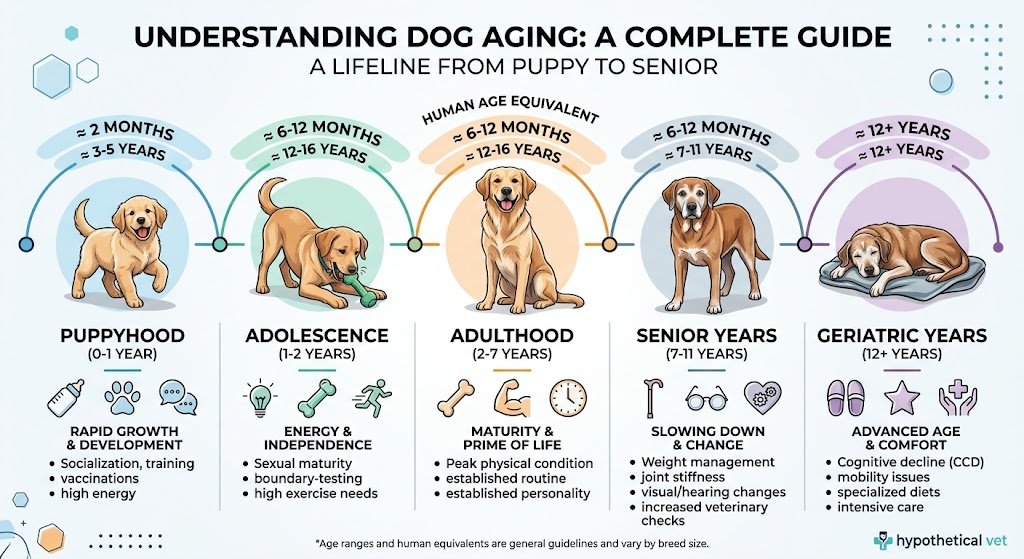
Dog Years to Human Years Chart
Quick Dog Age Conversion Chart
The table below provides a quick estimate of how a dog’s age compares to human years. These values are based on modern veterinary aging models and are intended as general guidelines. Actual aging can vary depending on breed, size, genetics, and overall health.
| Dog Age | Human-Equivalent Age* | Typical Life Stage |
|---|---|---|
| 1 year | 15 years | Young Adult |
| 2 years | 24 years | Adult |
| 3 years | 28 years | Adult |
| 4 years | 32 years | Adult |
| 5 years | 36 years | Adult |
| 6 years | 40 years | Mature Adult |
| 7 years | 44 years | Mature Adult |
| 8 years | 48 years | Mature Adult |
| 9 years | 52 years | Mature Adult |
| 10 years | 56 years | Senior |
| 11 years | 60 years | Senior |
| 12 years | 64 years | Senior |
| 13 years | 68 years | Senior |
| 14 years | 72 years | Senior |
| 15 years | 76 years | Senior |
*Values are approximate and may differ slightly depending on the calculation method used.
How to Read the Chart
Use your dog’s current age to find its estimated human-equivalent age. For example:
- A 1-year-old dog is roughly equivalent to a 15-year-old human.
- A 2-year-old dog is approximately 24 human years old.
- A 10-year-old dog is generally comparable to a 56-year-old human.
Keep in mind that these are estimates, and individual dogs may age differently based on breed size and overall health.
Why the Chart Is Only an Estimate
No single chart can accurately represent every dog. Several factors influence how quickly a dog ages, including:
- Breed size
- Genetics
- Diet and nutrition
- Exercise and activity level
- Body weight
- Preventive healthcare
- Existing medical conditions
For this reason, a dog age calculator often provides a more personalized estimate than a static age chart.
Summary
A dog years to human years chart offers a quick way to estimate your dog’s human-equivalent age. While it provides a useful reference, the results are approximate and should be interpreted alongside factors such as breed, size, and overall health.
Key Points
- The chart converts dog years into estimated human years.
- Dogs age rapidly during their first two years and more gradually afterward.
- Human-equivalent ages are approximate, not exact.
- Breed size and health can significantly affect aging.
- A dog age calculator provides more personalized results than a fixed conversion chart
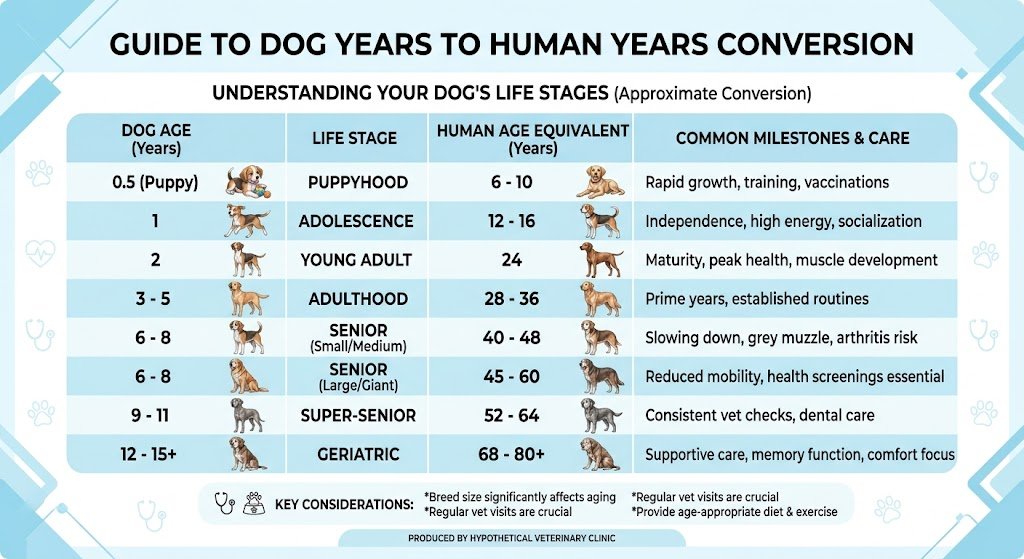
Dog Life Stages by Age
Puppy (0–1 Year)
The puppy stage is marked by rapid growth, learning, and development. During the first year, dogs mature much faster than humans, making this the most important period for proper nutrition, training, vaccinations, and socialization.
Young Adult (1–3 Years)
Most dogs reach physical maturity between one and three years of age, although larger breeds may take longer. Young adult dogs are typically energetic, active, and require regular exercise, balanced nutrition, and consistent preventive healthcare.
Adult (3–6 Years)
Adult dogs are generally in their healthiest stage of life. Maintaining a healthy weight, providing routine veterinary checkups, and ensuring daily physical and mental stimulation can help support long-term well-being during these years.
Mature (7–9 Years)
As dogs enter the mature stage, they may begin to slow down and show early signs of aging. Some may require adjustments to their diet, exercise routine, and health screenings to detect age-related conditions as early as possible.
Senior (10–12 Years)
Senior dogs often experience reduced energy levels, changes in mobility, and an increased risk of health issues such as arthritis, dental disease, and vision or hearing loss. More frequent veterinary visits and age-appropriate care become increasingly important.
Geriatric (13+ Years)
Dogs aged 13 years or older are generally considered geriatric, although this can vary by breed and size. At this stage, they benefit from regular health monitoring, comfortable living conditions, gentle exercise, and a diet tailored to senior needs to help maintain their quality of life.
Dog Life Stages at a Glance
| Life Stage | Typical Age | Characteristics |
|---|---|---|
| Puppy | 0–1 year | Rapid growth, learning, and development |
| Young Adult | 1–3 years | Physically mature, active, and energetic |
| Adult | 3–6 years | Stable health and peak physical condition |
| Mature | 7–9 years | Early signs of aging may appear |
| Senior | 10–12 years | Reduced activity and increased healthcare needs |
| Geriatric | 13+ years | Advanced age requiring additional care and monitoring |
Summary
A dog’s life progresses through six main stages, from puppyhood to the geriatric years. Understanding these stages helps owners provide age-appropriate nutrition, exercise, training, and healthcare, ensuring better quality of life throughout every phase.
Key Points
- Dogs pass through six primary life stages.
- The first year is the fastest period of growth and development.
- Adult dogs benefit from maintaining a healthy lifestyle and regular veterinary care.
- Mature and senior dogs often require more frequent health monitoring.
- Life stage timing can vary depending on a dog’s breed, size, and overall health.
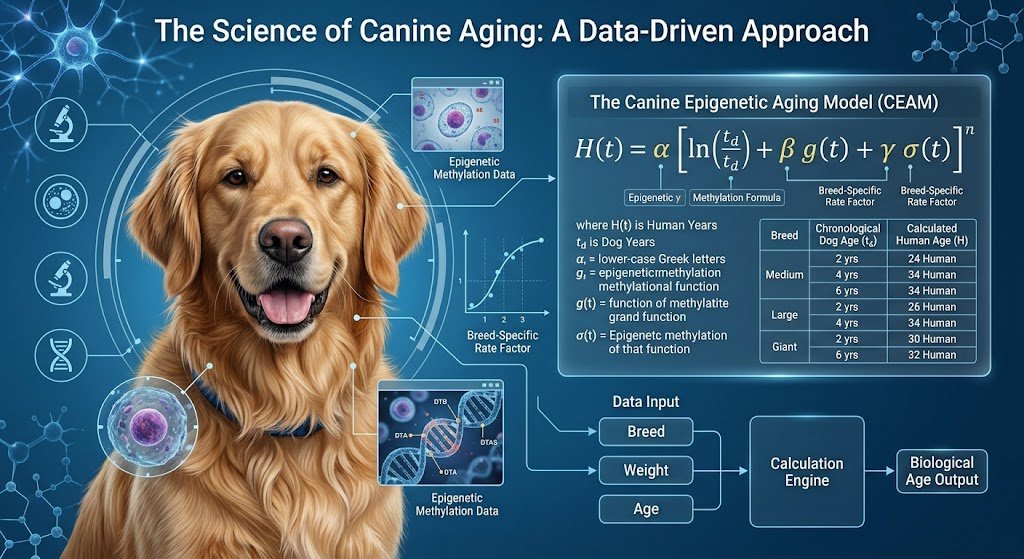
How Breed Size Affects Dog Age
Why Breed Size Matters
Breed size plays a major role in how quickly a dog ages. In general, smaller dogs tend to live longer and age more slowly during adulthood, while larger and giant breeds often have shorter lifespans and may reach senior status earlier.
This means two dogs with the same chronological age can have different biological ages depending on their size.
Small Breeds
Small breeds usually have the longest life expectancy and often remain active well into their senior years. They mature quickly during puppyhood but generally age more slowly as adults.
Examples include:
- Chihuahua
- Yorkshire Terrier
- Pomeranian
Typical lifespan: 12–16+ years
Medium Breeds
Medium-sized dogs generally have a balanced aging pattern and lifespan. They often become seniors slightly earlier than small breeds but later than large breeds.
Examples include:
- Border Collie
- Bulldog
- Cocker Spaniel
Typical lifespan: 10–14 years
Large Breeds
Large dogs typically age faster after reaching adulthood. They may show signs of aging sooner and often have shorter lifespans than smaller breeds.
Examples include:
- German Shepherd
- Labrador Retriever
- Golden Retriever
Typical lifespan: 8–12 years
Giant Breeds
Giant breeds generally have the shortest lifespans and tend to reach senior status earlier than other dogs. Their rapid growth rate is believed to contribute to faster aging.
Examples include:
- Great Dane
- Saint Bernard
- Mastiff
Typical lifespan: 6–10 years
Breed Size Aging Comparison
| Breed Size | Typical Lifespan | Senior Age Often Begins |
|---|---|---|
| Small | 12–16+ years | 10–12 years |
| Medium | 10–14 years | 8–10 years |
| Large | 8–12 years | 7–8 years |
| Giant | 6–10 years | 5–7 years |
How This Affects Dog Age Calculators
Advanced dog age calculators may adjust results based on breed size because aging patterns differ significantly among dogs. A 7-year-old small breed dog and a 7-year-old giant breed dog can have very different health profiles and life expectancies.
For the most accurate estimate, choose a dog age calculator that considers breed size in addition to chronological age.
Summary
Breed size is one of the most important factors affecting canine aging. Small breeds generally live longer and age more slowly, while large and giant breeds tend to age faster and have shorter lifespans. This is why modern dog age calculators often account for breed size when estimating human-equivalent age.
Key Points
- Breed size significantly influences aging and lifespan.
- Small breeds usually live the longest.
- Large and giant breeds tend to age faster.
- Dogs of the same age can have different biological ages based on size.
- Advanced dog age calculators may include breed-size adjustments for better accuracy.
Common Mistakes When Calculating Dog Age
Assuming One Dog Year Equals Seven Human Years
The most common mistake is believing that every dog year equals seven human years. This outdated rule does not reflect how dogs actually age. Puppies mature much faster during their first two years, while aging slows as they grow older.
Ignoring Breed Size
Dogs of different sizes age at different rates. Small breeds generally live longer than large and giant breeds, so using the same age conversion for every dog can lead to inaccurate results.
Using Outdated Age Charts
Many older dog age charts rely on the traditional 7-year rule. Modern dog age calculators use updated veterinary research to provide more realistic estimates based on canine aging patterns.
Overlooking Health and Lifestyle
A dog’s biological age may differ from its chronological age. Factors such as nutrition, exercise, body weight, genetics, and preventive healthcare can all influence how quickly a dog ages.
Treating Calculator Results as Exact
Dog age calculators provide estimates rather than exact measurements. They are useful for understanding a dog’s approximate human-equivalent age but should not replace professional veterinary advice when assessing a dog’s health or life expectancy.
Best Practices for Accurate Age Estimation
For the most reliable results:
- Use a modern dog age calculator instead of the 7-year rule.
- Consider your dog’s breed and size.
- Keep your dog’s age records up to date.
- Use the calculator as a general guide rather than an exact measure.
- Consult your veterinarian for age-related health assessments.
Summary
Dog age calculations are most accurate when based on modern veterinary research rather than outdated conversion rules. Considering factors such as breed size, health, and lifestyle provides a more realistic estimate of a dog’s human-equivalent age.
Key Points
- The 7-year rule is an outdated estimation method.
- Breed size has a significant impact on canine aging.
- Modern dog age calculators provide more accurate estimates.
- Health and lifestyle influence a dog’s biological age.
- Calculator results should be used as a guide, not as an exact measurement.
Conclusion
A Dog Age Calculator is a simple yet valuable tool for estimating your dog’s age in human years using modern veterinary research. Unlike the outdated 7-year rule, today’s calculators account for the fact that dogs mature rapidly during their early years and age at different rates depending on their breed and size.
While no calculator can determine a dog’s exact biological age, it provides a more realistic understanding of your pet’s life stage. Combined with regular veterinary care, proper nutrition, exercise, and preventive healthcare, a dog age calculator can help you make informed decisions that support your dog’s health and well-being throughout every stage of life.
FAQs
How do I calculate my dog’s age in human years?
The easiest way is to use a modern dog age calculator, which estimates human-equivalent age based on current veterinary research instead of the traditional 7-year rule.
Is one dog year equal to seven human years?
No. The 7-year rule is an outdated guideline. Dogs age much faster during their first two years, and their aging rate changes as they grow older.
Are dog age calculators accurate?
Modern dog age calculators provide reliable estimates based on scientific aging models. However, the results are approximate and can vary depending on breed, size, genetics, and overall health.
Does breed size affect a dog’s age?
Yes. Small breeds generally live longer and age more slowly than large or giant breeds. Many advanced dog age calculators consider breed size when estimating human-equivalent age.
Can I use a dog age calculator for puppies?
Yes. Most dog age calculators can estimate a puppy’s human-equivalent age, although puppies develop much more rapidly during their first year than adult dogs.
What is the average lifespan of a dog?
A dog’s lifespan depends largely on its breed and size. Small breeds often live 12–16 years or longer, while large and giant breeds typically have shorter lifespans ranging from 6–12 years.
Should I rely only on a dog age calculator?
No. A dog age calculator is a helpful guide but should not replace professional veterinary advice. Regular health checkups remain the best way to monitor your dog’s overall health and aging.