A dog calorie calculator helps estimate how many calories your dog needs each day based on factors such as body weight, age, activity level, body condition, and life stage. It provides a practical starting point for planning balanced meals and maintaining a healthy weight.
Knowing your dog’s daily calorie needs can help prevent overfeeding, support healthy growth, improve weight management, and ensure your pet receives enough energy for daily activities. Whether you have a puppy, an active adult dog, a senior dog, or a working breed, calorie requirements vary and should be adjusted accordingly.
This guide explains how a dog calorie calculator works, how to calculate dog calories, what affects a dog’s energy needs, and how to use the results to determine appropriate food portions. You’ll also learn about calorie formulas, weight management strategies, and common mistakes to avoid when estimating your dog’s daily calorie intake.
Summary
A dog calorie calculator estimates your dog’s daily energy needs using key factors like weight, age, activity level, and life stage. It helps you calculate daily calorie requirements, make informed feeding decisions, and support long-term health and weight management.
Key Points
- A dog calorie calculator estimates daily calorie requirements.
- Calculations consider weight, age, activity level, and body condition.
- Calorie needs differ for puppies, adults, seniors, and working dogs.
- The results can help determine appropriate food portions.
- Accurate calorie intake supports healthy weight, growth, and overall well-being.
More About Dog Visit : Dog Age Calculator
How a Dog Calorie Calculator Works
A dog calorie calculator estimates your dog’s daily energy needs using veterinary nutrition formulas. It combines your dog’s physical characteristics with lifestyle factors to calculate the number of calories needed to maintain, lose, or gain weight.
What the Calculator Measures
Most dog calorie calculators use the following information:
- Current body weight
- Age or life stage
- Activity level
- Body condition
- Neuter or spay status
- Pregnancy or nursing status (if applicable)
- Weight goal (maintenance, loss, or gain)
These inputs help generate a more accurate estimate of your dog’s daily calorie needs.
Information Required
The more accurate the information you provide, the more reliable the calorie estimate will be. Body weight is the most important input, while activity level and life stage help adjust the final recommendation.
| Information | Why It Matters |
|---|---|
| Body weight | Forms the basis of calorie calculations |
| Age | Puppies and seniors have different energy needs |
| Activity level | Active dogs burn more calories |
| Body condition | Helps determine whether calories should be adjusted |
| Reproductive status | Neutered, pregnant, or nursing dogs have different requirements |
| Weight goal | Supports maintenance, weight loss, or weight gain |
How Calories Are Estimated
Most calculators follow a two-step process:
- Calculate the Resting Energy Requirement (RER) based on body weight.
- Apply a Maintenance Energy Requirement (MER) multiplier according to your dog’s age, activity level, and lifestyle.
This method produces an estimated daily calorie requirement rather than an exact value. Regularly monitoring your dog’s weight and body condition helps determine whether calorie intake should be adjusted over time.
Summary
A dog calorie calculator estimates daily calorie needs by combining your dog’s weight with factors such as age, activity level, body condition, and lifestyle. It first calculates the Resting Energy Requirement (RER) and then adjusts it using Maintenance Energy Requirement (MER) multipliers to provide a practical daily calorie estimate.
Key Points
- Dog calorie calculators use veterinary nutrition formulas.
- Body weight is the primary factor in the calculation.
- Age, activity level, and body condition influence calorie needs.
- Most calculators estimate calories using RER and MER.
- Results should be reviewed periodically as your dog’s weight and lifestyle change.

Dog Calorie Formula Explained
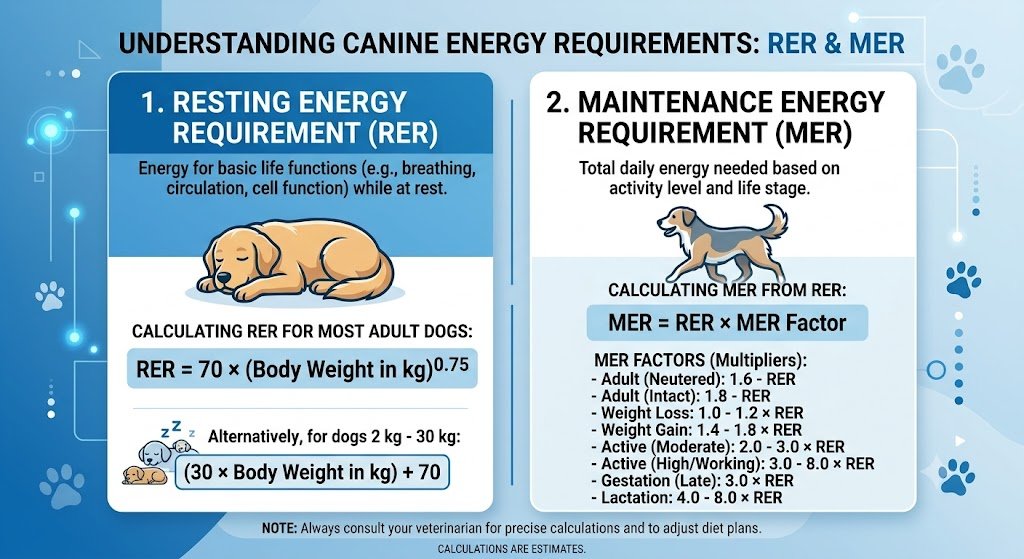
A dog calorie calculator uses two widely accepted veterinary nutrition formulas to estimate your dog’s daily energy needs: Resting Energy Requirement (RER) and Maintenance Energy Requirement (MER). RER calculates the calories needed for basic body functions, while MER adjusts that value based on your dog’s age, activity level, and lifestyle.
Resting Energy Requirement (RER)
Resting Energy Requirement (RER) is the number of calories a dog needs each day to support essential body functions while at rest, such as breathing, circulation, digestion, and maintaining body temperature.
The standard RER formula is:
RER = 70 × (Body Weight in kg)0.75
For dogs weighing between 2 kg and 45 kg, a simplified formula is often used:
RER = (30 × Body Weight in kg) + 70
This simplified calculation provides a close estimate and is commonly used in clinical practice.
Maintenance Energy Requirement (MER)
Maintenance Energy Requirement (MER) estimates the total calories a dog needs each day after accounting for factors like activity level, life stage, reproductive status, and health.
The formula is:
MER = RER × Activity Multiplier
Because every dog has different energy requirements, the activity multiplier helps personalize the daily calorie estimate.
Common Activity Multipliers
| Dog Category | MER Multiplier |
|---|---|
| Weight loss | 1.0 × RER |
| Inactive adult | 1.2–1.4 × RER |
| Average adult | 1.4–1.6 × RER |
| Active adult | 1.6–2.0 × RER |
| Working or highly active dog | 2.0–5.0 × RER |
| Puppy (0–4 months) | 3.0 × RER |
| Puppy (4 months to adult) | 2.0 × RER |
Example Calculation
Suppose your dog:
- Weighs 10 kg
- Is an average active adult
Step 1: Calculate the RER.
- RER = 70 × (10)^0.75
- RER ≈ 394 kcal/day
Step 2: Apply the MER multiplier.
- MER = 394 × 1.6
- Estimated daily calorie requirement ≈ 630 kcal/day
This estimated calorie requirement can then be matched with your dog’s food label to determine the appropriate daily feeding amount.
Why These Formulas Matter
RER and MER provide a scientific starting point for estimating daily calorie needs. However, they are estimates rather than exact values. Regularly monitoring your dog’s weight, body condition, and overall health helps determine whether calorie intake should be adjusted over time.
Summary
A dog calorie calculator estimates daily calorie needs by first calculating the Resting Energy Requirement (RER) and then applying a Maintenance Energy Requirement (MER) multiplier based on activity level and life stage. This approach provides a practical estimate for maintaining a healthy weight and supporting overall nutrition.
Key Points
- RER estimates calories needed for basic body functions at rest.
- MER adjusts the RER based on activity, age, and lifestyle.
- The simplified RER formula is commonly used for dogs weighing 2–45 kg.
- Activity multipliers help personalize daily calorie recommendations.
- Use the estimated calories to calculate appropriate food portions and adjust them as your dog’s needs change.
Factors That Affect a Dog’s Daily Calorie Needs
A dog’s daily calorie requirement depends on more than just body weight. Several factors influence how much energy your dog uses each day, which is why two dogs of the same size may need different calorie intakes.
Body Weight
Body weight is the primary factor used in calorie calculations. Larger dogs generally require more calories than smaller dogs, although their calorie needs do not increase in a perfectly linear way.
Age and Life Stage
A dog’s nutritional needs change throughout its life.
- Puppies need more calories to support rapid growth and development.
- Adult dogs require calories to maintain a healthy weight and energy level.
- Senior dogs often need fewer calories due to a slower metabolism and reduced activity.
Activity Level
The more active your dog is, the more calories it burns. Dogs that exercise frequently, participate in sports, or work regularly require higher calorie intake than dogs with a sedentary lifestyle.
| Activity Level | Typical Calorie Need |
|---|---|
| Low | Lower than average |
| Moderate | Average maintenance |
| High | Higher than average |
| Working or athletic | Significantly higher |
Breed Size
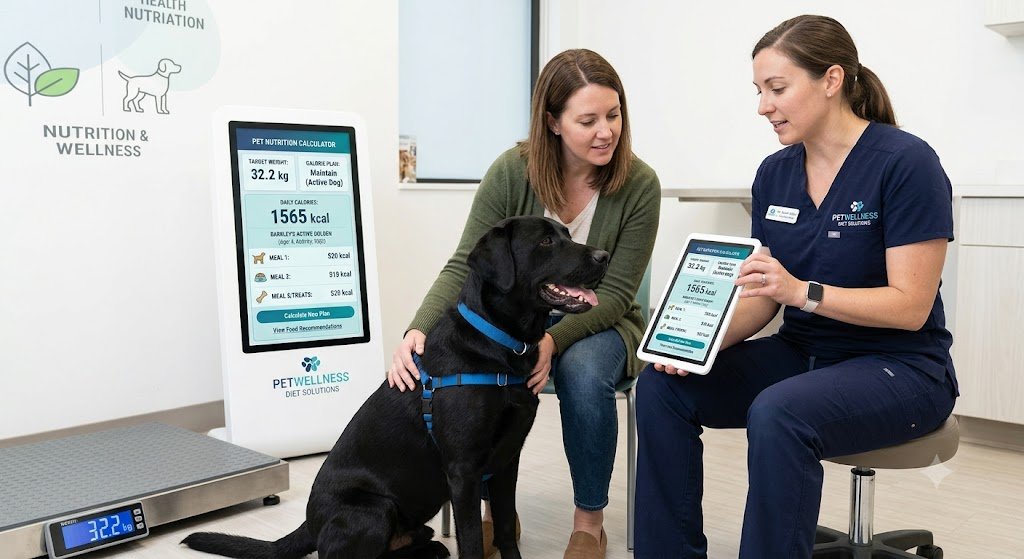
Breed size influences metabolism and energy requirements. Small breeds tend to have faster metabolisms and often need more calories per kilogram of body weight, while larger breeds generally require more total calories each day.
Body Condition Score (BCS)
Body Condition Score (BCS) helps determine whether a dog is underweight, at an ideal weight, or overweight. If your dog is above or below its ideal body condition, calorie intake may need to be adjusted accordingly.
Neutered or Intact Status
Neutered or spayed dogs often have lower energy requirements because their metabolism may slow after surgery. Intact dogs may require slightly more calories, depending on their activity and overall condition.
Pregnancy and Nursing
Pregnant and nursing dogs have significantly increased energy demands. Their calorie intake should be adjusted gradually to support healthy fetal development and milk production.
Health Conditions
Certain medical conditions can affect calorie needs. Dogs recovering from surgery, managing chronic illnesses, or following therapeutic diets may require specialized calorie recommendations from a veterinarian.
Summary
Daily calorie needs vary based on body weight, age, activity level, breed size, body condition, reproductive status, and overall health. Considering all these factors helps produce a more accurate calorie estimate and supports healthier feeding decisions.
Key Points
- Body weight is the foundation of calorie calculations.
- Puppies and highly active dogs typically require more calories.
- Senior and less active dogs often need fewer calories.
- Body Condition Score helps guide calorie adjustments.
- Pregnancy, nursing, and certain health conditions can significantly change daily calorie requirements.
- Regularly reassess your dog’s calorie needs as its lifestyle and health change.
Daily Dog Calorie Requirements by Weight
While every dog’s calorie needs vary based on age, activity level, and overall health, body weight provides a useful starting point. The table below shows approximate Resting Energy Requirement (RER) and estimated Maintenance Energy Requirement (MER) for an average adult dog.
These values are estimates and should be adjusted for puppies, senior dogs, highly active dogs, working dogs, or dogs with specific health conditions.
Estimated Daily Calories by Dog Weight
| Dog Weight | RER (Calories/Day) | Estimated MER (Average Adult) |
|---|---|---|
| 2 kg (4.4 lb) | 118 | 165–190 |
| 5 kg (11 lb) | 234 | 325–375 |
| 10 kg (22 lb) | 394 | 550–630 |
| 15 kg (33 lb) | 534 | 750–855 |
| 20 kg (44 lb) | 662 | 925–1,060 |
| 25 kg (55 lb) | 780 | 1,090–1,250 |
| 30 kg (66 lb) | 898 | 1,255–1,435 |
| 35 kg (77 lb) | 1,006 | 1,410–1,610 |
| 40 kg (88 lb) | 1,109 | 1,550–1,775 |
| 45 kg (99 lb) | 1,208 | 1,690–1,935 |
| 50 kg (110 lb) | 1,302 | 1,820–2,085 |
How to Use This Table
- Find your dog’s current body weight.
- Locate the estimated daily calorie range.
- Adjust the calorie target based on your dog’s age, activity level, and weight goal.
- Use the calorie recommendation to determine the correct amount of dog food based on its calorie content.
Keep in Mind
These calorie estimates are intended for healthy adult dogs with average activity levels. Dogs that are growing, pregnant, nursing, highly active, overweight, underweight, or recovering from illness may require more or fewer calories than shown in the table.
Summary
A weight-based calorie chart provides a quick estimate of your dog’s daily energy needs. However, body weight is only one part of the calculation, so factors such as activity level, life stage, and health should always be considered before deciding how much to feed.
Key Points
- Body weight provides the starting point for estimating daily calorie needs.
- The table shows approximate RER and MER values for average adult dogs.
- Actual calorie requirements vary with age, activity, and health.
- Use the calorie estimate together with your dog food’s calorie information to determine daily portions.
- Recalculate calorie needs whenever your dog’s weight, lifestyle, or health changes.
How to Calculate Food Portions from Calories
Knowing your dog’s daily calorie requirement is only the first step. To determine how much food to feed, compare the recommended daily calories with the calorie content listed on your dog’s food packaging.
Check the Dog Food Label
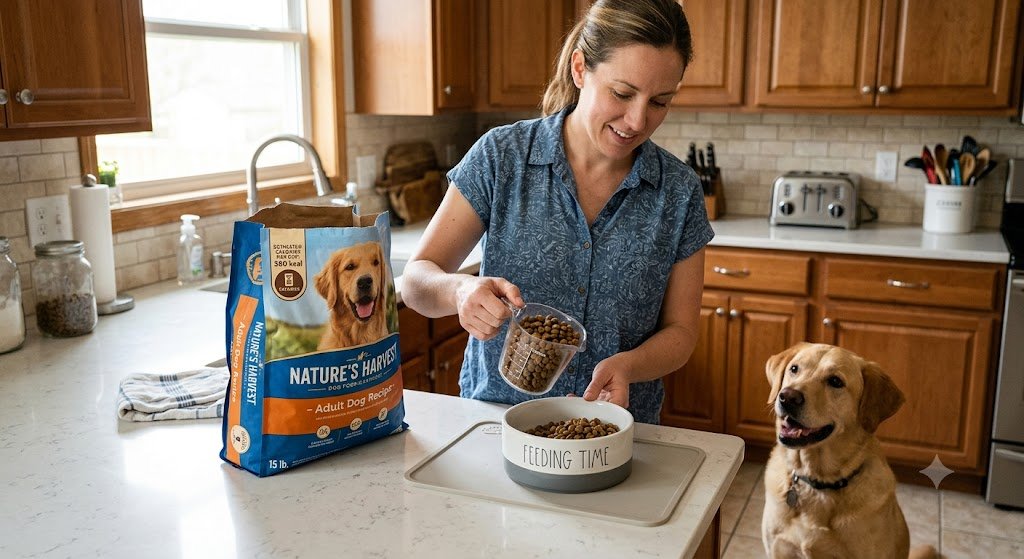
Most commercial dog foods display their calorie content as kilocalories (kcal) per cup, can, tray, or kilogram. This information is usually found in the guaranteed analysis or feeding guide.
Look for values such as:
- kcal per cup (dry food)
- kcal per can (wet food)
- kcal per tray or pouch
- kcal per kilogram or gram
Calculate the Daily Food Amount
Use this simple formula:
Daily Food Amount = Daily Calorie Requirement ÷ Calories per Serving
This calculation estimates how many cups, cans, or grams of food your dog should eat each day.
Example Calculation
Suppose:
- Your dog’s daily calorie requirement = 800 kcal
- Dog food contains 400 kcal per cup
Calculation:
800 ÷ 400 = 2 cups per day
If you feed your dog twice daily, divide the amount into equal meals.
| Daily Calories Needed | Food Calories | Daily Food Amount |
|---|---|---|
| 600 kcal | 300 kcal per cup | 2 cups |
| 800 kcal | 400 kcal per cup | 2 cups |
| 900 kcal | 450 kcal per cup | 2 cups |
| 1,200 kcal | 400 kcal per cup | 3 cups |
Don’t Forget Treat Calories
Treats contribute to your dog’s daily calorie intake. To avoid overfeeding, treats should generally make up no more than 10% of your dog’s total daily calories, while the remaining calories should come from a complete and balanced diet.
Adjust Portions as Needed
Your dog’s ideal food portion may change over time. Monitor body weight and Body Condition Score (BCS), then increase or decrease food portions if your dog is gaining or losing weight unexpectedly.
Summary
Converting calories into food portions is simple once you know your dog’s daily calorie requirement and the calorie content of the food. Regularly reviewing portions and accounting for treats helps maintain a healthy weight and balanced diet.
Key Points
- Check the calorie content on your dog’s food label.
- Divide daily calorie needs by the calories per serving to determine the feeding amount.
- Split the daily portion into one or more meals.
- Count treats as part of the total daily calories.
- Reassess food portions whenever your dog’s weight, activity level, or diet changes.
Dog Calorie Recommendations by Life Stage
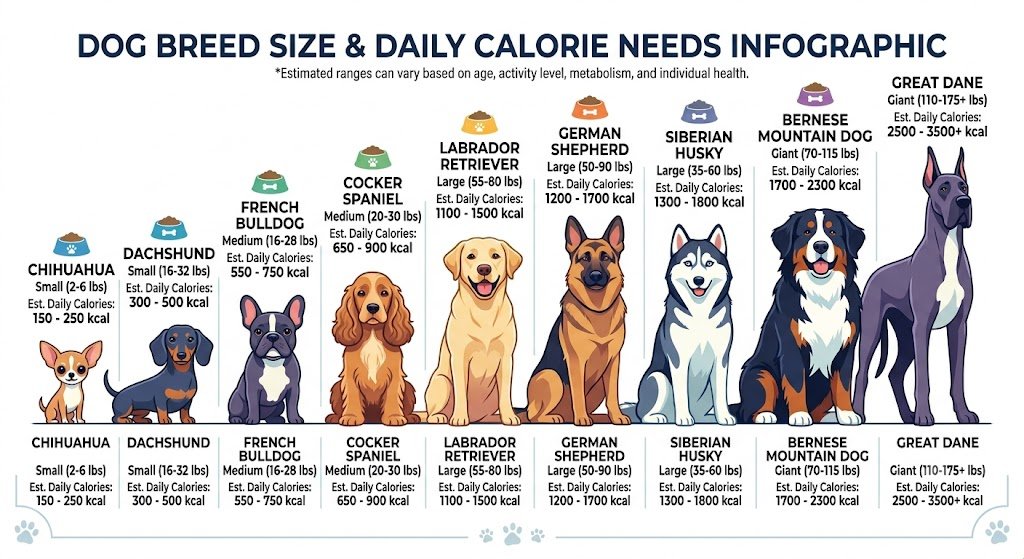
A dog’s calorie needs change throughout its life. Growth, aging, and activity levels all affect how much energy is required each day. Feeding the right number of calories at each life stage helps support healthy development, weight management, and overall well-being.
Puppies
Puppies require more calories than adult dogs because they are growing rapidly and developing muscles, bones, and organs. Their calorie needs are highest during the first few months of life and gradually decrease as they approach adulthood.
Feed puppies a complete and balanced puppy food and adjust portions regularly as they grow.
Adult Dogs
Healthy adult dogs need enough calories to maintain their ideal body weight and support daily activities. Most adult dogs can maintain a healthy weight by consuming calories based on their Maintenance Energy Requirement (MER), with adjustments made for their activity level.
Senior Dogs
Senior dogs often become less active and may have a slower metabolism, reducing their daily calorie needs. However, some older dogs lose muscle mass or have medical conditions that require dietary adjustments.
Monitor weight regularly and adjust calorie intake to maintain a healthy Body Condition Score (BCS).
Working and Highly Active Dogs
Working, sporting, hunting, herding, and highly active dogs burn significantly more energy than the average pet dog. They generally require more calories to maintain body condition and performance, especially during periods of intense activity.
Pregnant and Nursing Dogs
Pregnant and nursing dogs have substantially higher energy requirements to support fetal growth and milk production. Their calorie intake should increase gradually during pregnancy and may rise considerably while nursing a litter.
Life Stage Comparison
| Life Stage | Typical Calorie Needs |
|---|---|
| Puppy | Highest for growth and development |
| Adult | Moderate for weight maintenance |
| Senior | Often lower due to reduced activity |
| Working or athletic | Much higher because of increased energy use |
| Pregnant or nursing | Significantly higher to support reproduction |
Summary
Calorie requirements vary throughout a dog’s life. Puppies and working dogs generally need more calories, while many senior dogs require fewer. Adjusting calorie intake based on life stage helps support healthy growth, maintain an ideal weight, and meet changing nutritional needs.
Key Points
- Puppies require more calories to support growth.
- Adult dogs need calories based on maintenance and activity level.
- Senior dogs often benefit from reduced calorie intake.
- Working and athletic dogs require significantly more energy.
- Pregnant and nursing dogs need increased calorie intake throughout reproduction.
- Review calorie needs regularly as your dog moves through different life stages.
Using a Dog Calorie Calculator for Weight Management
A dog calorie calculator is a useful tool for managing your dog’s weight. Whether your goal is weight loss, weight maintenance, or healthy weight gain, adjusting daily calorie intake can help achieve long-term results while supporting overall health.
Weight Loss
If your dog is overweight, reducing calorie intake can help promote gradual and healthy weight loss. Lower calorie intake should be combined with regular exercise and routine weight monitoring to avoid losing weight too quickly.
Avoid making drastic reductions in food, as this can lead to nutritional deficiencies and muscle loss.
Weight Maintenance
Dogs at an ideal weight should consume enough calories to maintain their current body condition. Continue monitoring your dog’s weight and Body Condition Score (BCS), adjusting calorie intake if activity levels or lifestyle change.
Weight Gain
Underweight dogs may require additional calories to regain a healthy body weight. Increasing calorie intake gradually with a balanced, nutrient-rich diet is generally more effective than feeding large amounts at once.
If unexplained weight loss continues, consult a veterinarian to rule out underlying health issues.
Monitor Your Dog’s Progress
A calorie calculator provides an estimate, but your dog’s actual needs may vary. Weigh your dog regularly and assess its Body Condition Score to determine whether calorie adjustments are needed.
Small changes in daily calories can have a significant impact over time, making regular monitoring an important part of successful weight management.
Weight Management Goals
| Goal | Calorie Adjustment | Recommended Approach |
|---|---|---|
| Weight loss | Reduce daily calories | Feed controlled portions and increase activity |
| Weight maintenance | Maintain recommended calories | Monitor weight and adjust as needed |
| Weight gain | Increase daily calories | Add calories gradually using a balanced diet |
Summary
A dog calorie calculator helps determine an appropriate calorie target for weight loss, maintenance, or weight gain. Tracking your dog’s weight, monitoring Body Condition Score, and making gradual calorie adjustments are key to achieving and maintaining a healthy body condition.
Key Points
- Use calorie calculations as a starting point for weight management.
- Reduce calories gradually for safe weight loss.
- Maintain calorie intake to preserve an ideal body weight.
- Increase calories slowly when helping an underweight dog gain weight.
- Monitor weight and Body Condition Score regularly to determine whether adjustments are needed.
- Consult a veterinarian if your dog’s weight changes unexpectedly or does not respond to dietary changes.
Common Mistakes When Calculating Dog Calories
Even with a dog calorie calculator, inaccurate information or poor feeding habits can lead to overfeeding or underfeeding. Avoiding these common mistakes helps ensure your dog receives the right amount of calories for its individual needs.
Using an Incorrect Body Weight
Entering an outdated or estimated weight can produce inaccurate calorie recommendations. Weigh your dog regularly and use its current weight when calculating daily calorie needs.
Ignoring Activity Level
Activity level has a significant impact on calorie requirements. A highly active dog burns far more calories than a dog with a sedentary lifestyle, so selecting the correct activity level is essential.
Overlooking Treats and Snacks
Treats, table scraps, and chews all contribute to your dog’s daily calorie intake. Ignoring these extra calories can result in unintentional weight gain over time.
Not Adjusting Calories for Life Stage
Puppies, senior dogs, pregnant dogs, and nursing dogs have different nutritional requirements. Using the same calorie target throughout your dog’s life can lead to underfeeding or overfeeding.
Ignoring Body Condition Score (BCS)
The calorie estimate should always be compared with your dog’s Body Condition Score. If your dog is becoming overweight or underweight, adjust calorie intake accordingly instead of relying solely on the calculator.
Changing Food Without Recalculating
Different dog foods contain different calorie densities. Switching to a new food without checking its calorie content may cause your dog to consume more or fewer calories than intended.
Not Monitoring Weight Regularly
A calorie calculator provides an estimate, not a permanent feeding recommendation. Regular weight checks help determine whether your dog’s calorie intake should be increased or decreased.
Common Mistakes at a Glance
| Mistake | Possible Result | How to Avoid It |
|---|---|---|
| Using incorrect body weight | Inaccurate calorie estimate | Weigh your dog regularly |
| Choosing the wrong activity level | Overfeeding or underfeeding | Select the closest activity category |
| Ignoring treats | Excess calorie intake | Count treats as part of daily calories |
| Not adjusting for life stage | Poor nutrition | Recalculate as your dog ages |
| Ignoring BCS | Weight management issues | Monitor body condition regularly |
| Switching food without checking calories | Incorrect portions | Compare calorie content before changing food |
Summary
Most calorie calculation errors occur because important factors such as body weight, activity level, treats, or life stage are overlooked. Reviewing your dog’s weight, body condition, and diet regularly helps keep calorie estimates accurate and supports long-term health.
Key Points
- Always use your dog’s current body weight.
- Choose the correct activity level when calculating calories.
- Include treats and snacks in the daily calorie total.
- Recalculate calorie needs as your dog grows or ages.
- Check the calorie content when changing dog food.
- Monitor weight and Body Condition Score to make timely adjustments.
When to Consult a Veterinarian
A dog calorie calculator provides a helpful estimate of your dog’s daily calorie needs, but it cannot replace professional veterinary advice. Some dogs have unique nutritional requirements that require an individualized feeding plan.
Unexpected Weight Changes
If your dog is gaining or losing weight despite following the recommended calorie intake, consult a veterinarian. Sudden or unexplained weight changes may indicate an underlying health condition that requires diagnosis and treatment.
Medical Conditions
Dogs with chronic health conditions often need specialized diets and calorie adjustments. Conditions that may affect calorie requirements include:
- Diabetes
- Kidney disease
- Liver disease
- Heart disease
- Thyroid disorders
- Digestive disorders
A veterinarian can recommend an appropriate calorie target and diet based on your dog’s medical needs.
Pregnancy and Nursing
Pregnant and nursing dogs require significantly more calories than healthy adult dogs. Regular veterinary checkups help ensure both the mother and puppies receive adequate nutrition throughout pregnancy and lactation.
Puppies and Senior Dogs
Although calorie calculators provide useful estimates, puppies and senior dogs may benefit from regular veterinary assessments to ensure their growth, body condition, and nutritional needs remain on track.
Prescription or Therapeutic Diets
Dogs eating prescription diets for weight management, allergies, gastrointestinal issues, or other medical conditions should follow the feeding guidelines provided by their veterinarian rather than relying solely on a calorie calculator.
Persistent Feeding Concerns
Seek professional advice if your dog:
- Refuses food regularly
- Eats excessively without gaining weight
- Experiences frequent digestive problems
- Has difficulty maintaining a healthy weight
- Shows noticeable changes in appetite or energy levels
Summary
A dog calorie calculator is an excellent starting point for estimating daily calorie needs, but some situations require professional guidance. Veterinary advice is especially important for dogs with medical conditions, unexpected weight changes, pregnancy, nursing, or specialized dietary requirements.
Key Points
- Consult a veterinarian for unexplained weight gain or weight loss.
- Dogs with medical conditions often require customized nutrition plans.
- Pregnant and nursing dogs need professional dietary guidance.
- Puppies and senior dogs benefit from regular nutritional assessments.
- Follow veterinary recommendations when feeding prescription or therapeutic diets.
- Use a calorie calculator as a guide, not a substitute for professional care.
Conclusion
A dog calorie calculator is a practical tool for estimating your dog’s daily energy requirements and creating an appropriate feeding plan. By considering factors such as body weight, age, activity level, life stage, and body condition, it provides a reliable starting point for maintaining a healthy weight and balanced nutrition.
Remember that calorie estimates are guidelines rather than fixed values. Monitor your dog’s weight, Body Condition Score (BCS), and overall health regularly, and adjust food portions as needed. For puppies, senior dogs, pregnant or nursing dogs, and pets with medical conditions, consult a veterinarian to develop a nutrition plan that meets their specific needs.
Frequently Asked Questions
How many calories should my dog eat each day?
A dog’s daily calorie needs depend on its weight, age, activity level, body condition, reproductive status, and overall health. A dog calorie calculator estimates the appropriate daily calorie intake using these factors, making it more accurate than relying on weight alone.
How do I calculate my dog’s daily calorie needs?
Most calculators first determine your dog’s Resting Energy Requirement (RER) and then apply a Maintenance Energy Requirement (MER) multiplier based on activity level and life stage. The result estimates the number of calories your dog needs each day.
What is the difference between RER and MER?
RER (Resting Energy Requirement) is the number of calories a dog needs to perform basic body functions while resting. MER (Maintenance Energy Requirement) adjusts the RER based on factors such as activity, age, and lifestyle to estimate total daily calorie needs.
How often should I recalculate my dog’s calorie needs?
Recalculate your dog’s calorie requirements whenever its weight, activity level, life stage, diet, or health changes. Regular weight checks can also help determine whether calorie adjustments are needed.
Can I use a dog calorie calculator for puppies?
Yes. Most dog calorie calculators include higher energy multipliers for puppies because they require more calories to support growth and development. Always feed a complete and balanced puppy food that meets their nutritional needs.
How do I convert calories into food portions?
Check the calorie content listed on your dog’s food label, then divide your dog’s daily calorie requirement by the calories per serving. This calculation estimates how many cups, grams, cans, or pouches of food your dog should receive each day.
Should treats be included in my dog’s daily calories?
Yes. Treats, chews, and table scraps all contribute to your dog’s total daily calorie intake. To help maintain a healthy weight, treats should generally account for no more than 10% of your dog’s daily calories.
Can two dogs of the same weight need different calorie amounts?
Yes. Dogs with the same body weight may have different calorie requirements due to differences in age, breed, activity level, body condition, metabolism, reproductive status, and overall health.
Summary
A dog calorie calculator helps answer common questions about daily calorie needs, feeding amounts, and weight management. While it provides a reliable estimate, monitoring your dog’s weight and consulting a veterinarian when needed will help ensure accurate long-term nutrition.
Key Points
- Daily calorie needs vary between individual dogs.
- RER and MER are the foundation of calorie calculations.
- Recalculate calories when your dog’s lifestyle or weight changes.
- Convert calories into food portions using your dog food’s calorie content.
- Include treats in your dog’s total daily calorie intake.
- Seek veterinary advice for dogs with medical conditions or unusual weight changes.