A Puppy Weight Calculator is an online tool that estimates how much a puppy is likely to weigh as an adult. It uses details such as the puppy’s current weight, age, breed, or breed size to predict its expected adult weight.
Many tools also function as a Dog Weight Calculator, allowing owners to estimate or track the healthy weight of growing puppies and adult dogs.
Purpose of a Puppy Weight Calculator
The primary purpose of a puppy weight calculator is to help pet owners understand their puppy’s expected growth and adult size. It provides an estimated weight range that can assist with planning nutrition, exercise, crate size, and overall long-term care.
A puppy weight calculator can also help identify unusual growth patterns that may require veterinary attention.
Who Should Use a Puppy Weight Calculator?
A puppy weight calculator is useful for:
- New puppy owners planning for their pet’s adult size.
- Owners of mixed-breed puppies estimating future weight.
- Breeders monitoring healthy puppy development.
- Pet adopters who don’t know how large their puppy will become.
- Veterinarians and pet professionals as a quick growth reference.
Why Knowing Your Puppy’s Adult Weight Matters
Estimating your puppy’s adult weight helps you prepare for its future needs and supports healthy development. It can help you:
- Choose the right food and portion sizes.
- Monitor healthy growth throughout puppyhood.
- Select the correct crate, bed, harness, and accessories.
- Plan appropriate exercise based on expected size.
- Understand when your puppy may reach full maturity.
Although a puppy weight calculator provides an estimate rather than an exact prediction, it offers a practical way to monitor growth and make informed decisions as your puppy develops.
Summary
A puppy weight calculator estimates a puppy’s expected adult weight using information such as age, current weight, and breed. It helps owners track healthy growth, prepare for their dog’s future size, and make better decisions about nutrition, exercise, and everyday care.
Key Points
- A puppy weight calculator predicts a puppy’s adult weight.
- Many tools also work as a dog weight calculator for tracking healthy weight.
- Estimates are based on factors such as age, current weight, and breed.
- The calculator helps owners plan for nutrition, equipment, and long-term care.
- Results are estimates and should be used alongside regular veterinary guidance.
Need More information about dogs Visit : Dog Pregnancy Calculator
How Does a Puppy Weight Calculator Work?
How Adult Weight Is Estimated
A Puppy Weight Calculator estimates a puppy’s adult weight by analyzing its current age, current weight, and expected growth rate. Most calculators compare this information with breed-specific growth patterns to predict how much the puppy will weigh when fully grown.
For mixed-breed puppies, the estimate is based on average growth trends rather than a specific breed standard.
Information Needed for the Calculation
Most puppy weight calculators require a few basic details, including:
- Current puppy weight
- Current age (weeks or months)
- Breed or breed size (if known)
- Gender (optional in some calculators)
The more accurate the information you provide, the more reliable the estimated adult weight will be.
Why Age and Breed Matter
A puppy’s growth rate changes as it develops. Young puppies gain weight quickly, while growth gradually slows as they approach adulthood. Breed also plays a significant role because different breeds mature at different rates.
For example:
- Small breeds usually reach their adult weight within 8–12 months.
- Medium breeds typically mature in 12–15 months.
- Large breeds often continue growing until 18 months.
- Giant breeds may keep growing for up to 24 months.
What Factors Can Affect the Prediction?
Although a puppy weight calculator provides a useful estimate, several factors can influence the final adult weight, including:
- Breed and breed size
- Genetics
- Nutrition and diet
- Exercise and activity level
- Overall health
- Medical conditions
- Spaying or neutering
- Environmental factors
Because every puppy grows differently, the calculator should be used as a guide rather than an exact prediction.
Summary
A puppy weight calculator predicts adult weight using your puppy’s age, current weight, and breed information. Since growth rates vary by breed and individual development, the results provide an estimated weight range instead of an exact final weight.
Key Points
- Puppy weight calculators estimate adult weight based on growth patterns.
- Current age and weight are the most important inputs.
- Breed size significantly affects growth and maturity.
- Genetics, nutrition, and health also influence the prediction.
- The estimated weight should be used as a guideline, not a guarantee.
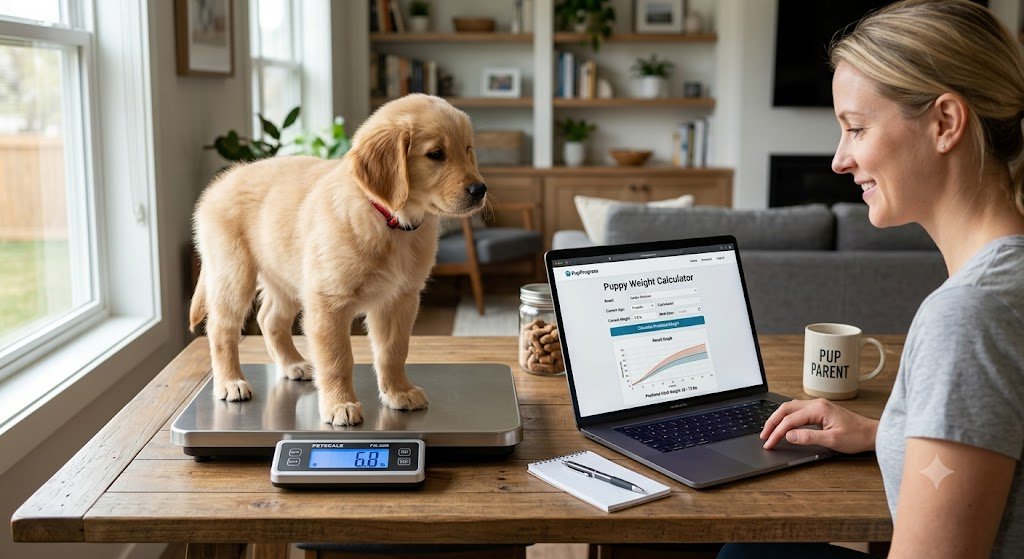
Puppy Weight Calculator Formula
How the Formula Estimates Adult Weight
A puppy weight calculator uses growth-based formulas to estimate how much a puppy will weigh when fully grown. Rather than relying on a single universal formula, most calculators combine your puppy’s age, current weight, and breed size with standard canine growth patterns to predict adult weight.
This approach provides a more realistic estimate because different breeds grow at different rates.
Common Puppy Weight Calculation Methods
The calculation method varies depending on the puppy’s age and breed. Some of the most commonly used estimation methods include:
- Comparing the puppy’s current weight with breed-specific growth charts.
- Using age-based growth multipliers for small, medium, large, and giant breeds.
- Applying historical growth data from similar breeds.
- Estimating growth based on developmental milestones.
Many online puppy weight calculators automatically select the most suitable method based on the information you enter.
Breed-Based Weight Estimation
Breed size is one of the biggest factors in predicting adult weight.
| Breed Size | Typical Adult Weight |
|---|---|
| Small | Up to 25 lbs (11 kg) |
| Medium | 26–60 lbs (12–27 kg) |
| Large | 61–100 lbs (28–45 kg) |
| Giant | Over 100 lbs (45+ kg) |
If your puppy’s breed is unknown or mixed, the estimate is based on average growth patterns, so the predicted weight may have a wider range.
Why There Isn’t One Universal Formula
Unlike age calculators, puppy weight prediction cannot rely on a single mathematical equation. Every breed has a unique growth curve, and individual puppies may grow faster or slower depending on genetics, nutrition, and overall health.
For this reason, modern puppy weight calculators use multiple growth models instead of one fixed formula.
Formula Limitations
Keep these limitations in mind when using a puppy weight calculator:
- Results are estimated, not guaranteed.
- Mixed-breed puppies may receive less precise predictions.
- Poor nutrition or health conditions can affect growth.
- Growth rates differ between individual puppies, even within the same breed.
- Weight predictions become more accurate as puppies get older.
Summary
A puppy weight calculator estimates adult weight using age, current weight, breed size, and established growth patterns. Since every puppy develops differently, modern calculators use multiple growth models instead of a single universal formula.
Key Points
- There is no single formula for predicting puppy weight.
- Most calculators combine age, weight, and breed information.
- Breed size has a major impact on adult weight estimates.
- Mixed-breed puppies may receive broader prediction ranges.
- Puppy weight calculators provide estimates, not exact adult weights.

Puppy Growth Chart by Age
Average Puppy Weight by Age
Puppies grow rapidly during their first year, but the rate of growth varies by breed and size. Small breeds mature sooner, while large and giant breeds continue growing for a longer period. The chart below provides a general guide to healthy puppy development.
| Puppy Age | Typical Growth Stage | Growth Rate |
|---|---|---|
| Birth–2 Weeks | Newborn | Very rapid development |
| 3–4 Weeks | Early Puppy | Steady weight gain |
| 5–8 Weeks | Weaning | Rapid growth |
| 2–3 Months | Young Puppy | Fast muscle and bone development |
| 4–6 Months | Adolescent Puppy | Continued rapid growth |
| 7–12 Months | Late Puppy | Growth begins to slow |
| 12–24 Months* | Large & Giant Breeds | Gradual growth until full maturity |
*Large and giant breeds may continue growing beyond 12 months.
Growth Milestones
As puppies grow, they reach several important milestones that influence their expected adult weight:
- 8 Weeks: Most puppies are ready to move to their new home.
- 3 Months: Rapid growth and increased activity.
- 6 Months: Many puppies reach around half to three-quarters of their adult weight, depending on breed.
- 12 Months: Most small and medium breeds are close to full size.
- 18–24 Months: Large and giant breeds typically reach full adult weight.
How to Use the Growth Chart
A puppy growth chart helps you compare your puppy’s development with typical growth patterns. To get the most accurate estimate:
- Weigh your puppy regularly using the same scale.
- Record weight at consistent intervals.
- Compare growth with dogs of a similar breed or size.
- Use a puppy weight calculator alongside the chart for a more personalized prediction.
- Consult a veterinarian if your puppy’s growth changes significantly or unexpectedly.
When Growth May Vary
Not every puppy follows the same growth timeline. Differences in development can result from:
- Breed and breed size
- Genetics
- Nutrition
- Exercise levels
- Overall health
- Medical conditions
Slight variations are normal, but significant changes should be discussed with a veterinarian.
Summary
A puppy growth chart provides a general timeline of healthy development from birth to adulthood. When combined with a puppy weight calculator, it helps owners track growth, estimate adult weight, and identify potential concerns early.
Key Points
- Puppies grow fastest during their first six months.
- Small breeds mature earlier than large and giant breeds.
- Regular weight tracking helps monitor healthy development.
- Growth charts provide general guidance, while calculators offer personalized estimates.
- Breed, nutrition, and health all influence a puppy’s growth rate.
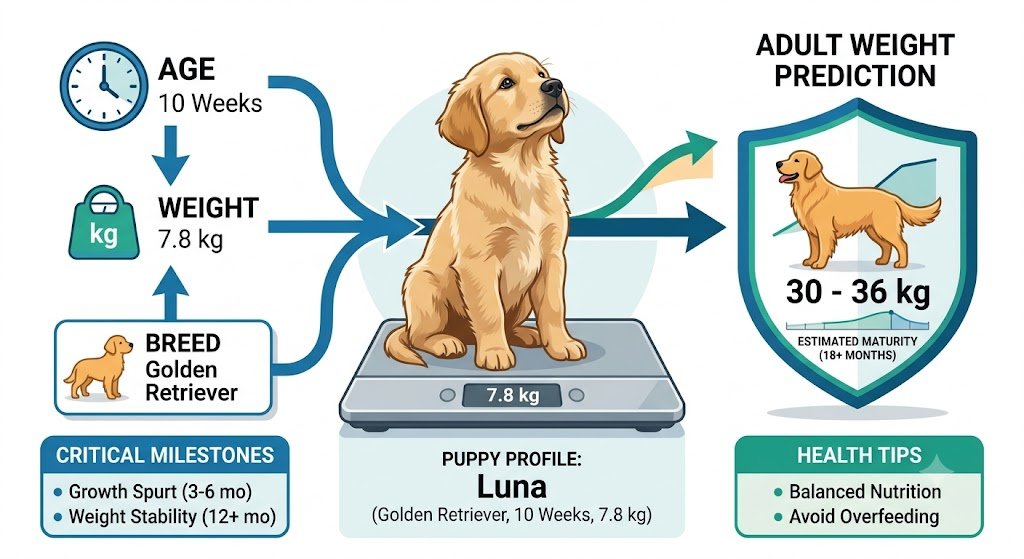
Average Puppy Weight by Breed Size
Small Breeds
Small-breed puppies grow quickly and usually reach their adult weight between 8 and 12 months. Although they mature earlier than larger dogs, they typically have the longest lifespan.
Examples:
- Chihuahua
- Pomeranian
- Yorkshire Terrier
Typical adult weight: Up to 25 lbs (11 kg)
Medium Breeds
Medium-breed puppies continue growing for a longer period and generally reach full size between 12 and 15 months.
Examples:
- Cocker Spaniel
- Border Collie
- Bulldog
Typical adult weight: 26–60 lbs (12–27 kg)
Large Breeds
Large-breed puppies experience steady growth during their first year and may continue developing until 18 months of age.
Examples:
- Labrador Retriever
- Golden Retriever
- German Shepherd
Typical adult weight: 61–100 lbs (28–45 kg)
Giant Breeds
Giant-breed puppies grow the longest and may not reach their full adult weight until 18–24 months. Their rapid growth requires balanced nutrition and regular veterinary monitoring.
Examples:
- Great Dane
- Saint Bernard
- Mastiff
Typical adult weight: Over 100 lbs (45+ kg)
Breed Size Comparison
| Breed Size | Typical Adult Weight | Full Growth Age |
|---|---|---|
| Small | Up to 25 lbs (11 kg) | 8–12 months |
| Medium | 26–60 lbs (12–27 kg) | 12–15 months |
| Large | 61–100 lbs (28–45 kg) | 15–18 months |
| Giant | Over 100 lbs (45+ kg) | 18–24 months |
Why Breed Size Matters
Breed size is one of the most important factors in predicting a puppy’s adult weight. Small breeds stop growing much sooner than large and giant breeds, which continue gaining weight for many more months. This is why most puppy weight calculators ask for your puppy’s breed or expected breed size to improve prediction accuracy.
Summary
Puppy growth and adult weight vary significantly by breed size. Small breeds mature quickly, while large and giant breeds require more time to reach full size. Knowing your puppy’s breed category helps a puppy weight calculator provide a more accurate adult weight estimate.
Key Points
- Small breeds mature the fastest.
- Large and giant breeds continue growing for up to two years.
- Breed size has a major impact on adult weight predictions.
- Growth timelines differ across breed categories.
- Providing breed information improves the accuracy of puppy weight calculators.
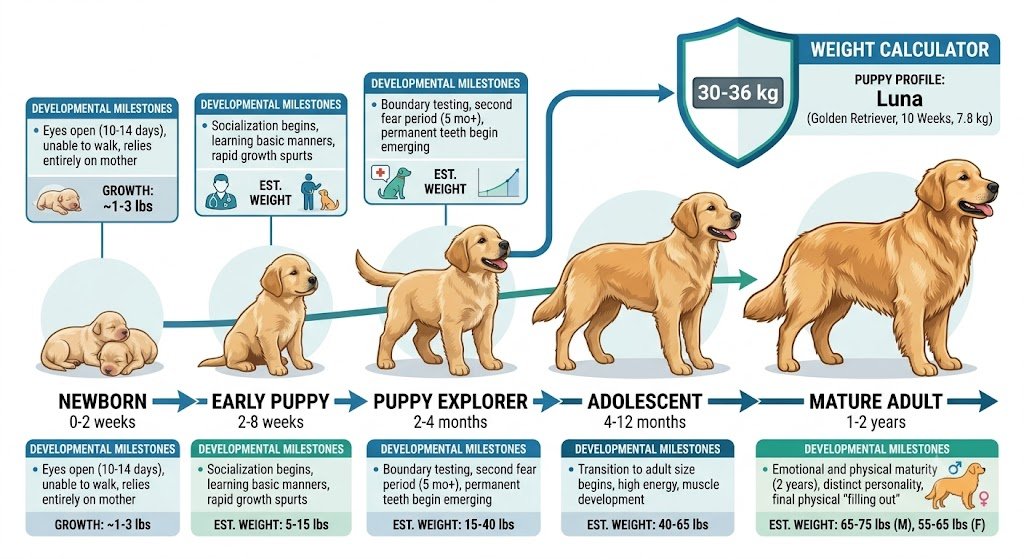
Factors That Affect Puppy Weight
Breed and Genetics
A puppy’s breed and genetics have the greatest influence on its adult weight. Purebred puppies generally follow predictable growth patterns, while mixed-breed puppies may have a wider range of possible adult weights.
Age
Puppies gain weight at different rates as they grow. Younger puppies experience rapid growth, while weight gain gradually slows as they approach adulthood. Entering the correct age into a puppy weight calculator is essential for an accurate estimate.
Nutrition
A balanced diet supports healthy growth and proper body development. Poor nutrition or overfeeding can affect weight gain, making a puppy either underweight or overweight.
Exercise and Activity Level
Regular exercise helps puppies build muscle and maintain a healthy body weight. However, excessive exercise during early development should be avoided, especially for large and giant breeds, to protect growing joints.
Overall Health
Health conditions, parasites, digestive issues, and chronic illnesses can slow a puppy’s growth or affect weight gain. Routine veterinary checkups help ensure healthy development.
Sex
Male and female puppies of the same breed often grow at slightly different rates. In many breeds, males typically reach a larger adult size than females, although individual differences are common.
Spaying or Neutering
Spaying or neutering can influence metabolism and energy requirements. While the procedure itself does not determine adult size, changes in diet and activity may affect body weight over time.
Environment and Lifestyle
A puppy’s living environment also contributes to healthy growth. Adequate sleep, reduced stress, proper care, and consistent feeding routines all support normal weight development.
Factors Affecting Puppy Weight at a Glance
| Factor | Impact on Growth |
|---|---|
| Breed & Genetics | Determines expected adult size and growth rate |
| Age | Influences the speed of weight gain |
| Nutrition | Supports healthy growth and development |
| Exercise | Helps maintain healthy body weight and muscle |
| Overall Health | Can increase or slow normal growth |
| Sex | May affect final adult size in some breeds |
| Spaying/Neutering | Can influence metabolism and weight management |
| Environment | Supports consistent and healthy development |
Summary
Several factors influence a puppy’s growth and adult weight, including breed, genetics, age, nutrition, exercise, and overall health. Considering these factors alongside a puppy weight calculator provides a more accurate estimate of your puppy’s expected adult size.
Key Points
- Breed and genetics have the biggest impact on adult weight.
- Correct age improves weight prediction accuracy.
- Proper nutrition is essential for healthy growth.
- Exercise and overall health influence normal development.
- Puppy weight calculators are most accurate when all relevant factors are considered.
Puppy Weight Calculator vs Dog Weight Calculator
What’s the Difference?
Although the terms are often used interchangeably, a Puppy Weight Calculator and a Dog Weight Calculator serve different purposes.
A puppy weight calculator predicts how much a puppy is expected to weigh when fully grown, while a dog weight calculator is primarily used to evaluate or estimate the healthy weight of an adult dog based on factors such as breed, size, or body condition.
When to Use a Puppy Weight Calculator
A puppy weight calculator is the better choice if you want to:
- Predict your puppy’s adult weight.
- Monitor healthy growth during puppyhood.
- Compare your puppy’s development with expected growth milestones.
- Plan for your dog’s future size and care requirements.
When to Use a Dog Weight Calculator
A dog weight calculator is more suitable for:
- Checking whether an adult dog is within a healthy weight range.
- Monitoring weight changes over time.
- Supporting weight management plans.
- Estimating an ideal weight based on breed and body condition.
Side-by-Side Comparison
| Feature | Puppy Weight Calculator | Dog Weight Calculator |
|---|---|---|
| Primary Purpose | Predict adult weight | Assess healthy weight |
| Best For | Puppies | Adult dogs |
| Uses Age | ✔ Yes | Sometimes |
| Uses Current Weight | ✔ Yes | ✔ Yes |
| Considers Breed Size | ✔ Yes | ✔ Yes |
| Estimates Future Weight | ✔ Yes | ✖ No |
| Tracks Healthy Weight | Limited | ✔ Yes |
Which Calculator Should You Choose?
Choose a puppy weight calculator if your dog is still growing and you want to estimate its adult size. If your dog has already reached adulthood, a dog weight calculator is the better option for evaluating and maintaining a healthy weight.
Many online tools combine both features, allowing you to estimate a puppy’s future weight and monitor an adult dog’s weight from the same calculator.
Summary
A puppy weight calculator predicts a puppy’s expected adult weight, while a dog weight calculator focuses on evaluating the healthy weight of adult dogs. Selecting the right calculator depends on your dog’s age and the information you need.
Key Points
- Puppy weight calculators estimate future adult weight.
- Dog weight calculators help assess healthy weight in adult dogs.
- Both calculators use factors such as weight and breed size.
- Puppy calculators are ideal for growing dogs, while dog weight calculators are better for mature dogs.
- Some online tools combine both functions for added convenience.
How Accurate Is a Puppy Weight Calculator?
Are Puppy Weight Calculators Reliable?
A puppy weight calculator can provide a reliable estimate of your puppy’s adult weight, especially when accurate information such as age, current weight, and breed is entered. While the prediction isn’t exact, it offers a realistic weight range based on typical canine growth patterns.
What Affects Accuracy?
Several factors influence how accurate a puppy weight calculator will be, including:
- Breed or breed mix
- Current age
- Current weight
- Genetics
- Nutrition
- Overall health
- Growth rate
The more complete and accurate the information, the more dependable the estimated adult weight.
Mixed-Breed Puppies
Weight predictions for mixed-breed puppies can be less precise because their adult size depends on the characteristics inherited from each parent. If the breed mix is unknown, calculators use average growth patterns, resulting in a broader estimated weight range.
When Is the Best Time to Use a Puppy Weight Calculator?
A puppy weight calculator can be used at any stage of growth, but predictions generally become more accurate as the puppy gets older and more growth data is available.
As your puppy grows, updating its weight and age regularly can provide a more refined estimate of its expected adult size.
Should You Rely Only on the Calculator?
No. A puppy weight calculator should be used as a planning tool rather than a guarantee of adult weight. Regular veterinary checkups, healthy nutrition, and growth monitoring remain the most reliable ways to ensure your puppy is developing normally.
Summary
A puppy weight calculator provides a useful estimate of adult weight based on growth patterns and available information. While it’s generally accurate for many puppies, factors such as breed, genetics, nutrition, and overall health can influence the final result.
Key Points
- Puppy weight calculators provide estimated, not exact, adult weights.
- Accurate age, weight, and breed information improve prediction accuracy.
- Mixed-breed puppies may have wider prediction ranges.
- Updating your puppy’s measurements over time produces better estimates.
- Use the calculator alongside regular veterinary care for the best assessment.

Tips for Monitoring Healthy Puppy Growth
Weigh Your Puppy Regularly
Regular weigh-ins help you monitor your puppy’s growth and identify unexpected changes early. For the most consistent results, use the same scale and weigh your puppy at the same time of day each week.
Feed a Balanced Puppy Diet
A high-quality puppy food formulated for your dog’s breed size provides the nutrients needed for healthy growth. Follow feeding guidelines and adjust portions based on your puppy’s age, activity level, and your veterinarian’s recommendations.
Track Growth Over Time
Keep a record of your puppy’s weight and compare it with a puppy growth chart or a puppy weight calculator. Tracking progress over several weeks provides a clearer picture of healthy development than relying on a single measurement.
Maintain a Healthy Body Condition
Weight alone doesn’t tell the whole story. Your puppy should have a healthy body condition, with a visible waist and ribs that can be felt without excessive fat covering them.
Schedule Regular Veterinary Checkups
Routine veterinary visits help ensure your puppy is growing at a healthy rate. Your veterinarian can assess body condition, identify nutritional deficiencies, and recommend changes if growth is too slow or too rapid.
Avoid Overfeeding
Overfeeding can lead to excessive weight gain, increasing the risk of joint problems and obesity later in life. Measure meals carefully and avoid giving too many treats or table scraps.
Healthy Puppy Growth Checklist
| Tip | Why It Matters |
|---|---|
| Weigh your puppy weekly | Tracks growth and detects changes early |
| Feed a balanced puppy diet | Supports healthy development |
| Use a puppy weight calculator | Estimates expected adult weight |
| Monitor body condition | Helps maintain a healthy weight |
| Visit your veterinarian regularly | Identifies growth concerns early |
| Avoid overfeeding | Reduces the risk of obesity |
Summary
Healthy puppy growth depends on proper nutrition, regular weight tracking, routine veterinary care, and maintaining a healthy body condition. Using a puppy weight calculator alongside these practices provides a better understanding of your puppy’s development.
Key Points
Tips for Monitoring Healthy Puppy Growth
Weigh Your Puppy Regularly
Regular weigh-ins help you monitor your puppy’s growth and identify unexpected changes early. For the most consistent results, use the same scale and weigh your puppy at the same time of day each week.
Feed a Balanced Puppy Diet
A high-quality puppy food formulated for your dog’s breed size provides the nutrients needed for healthy growth. Follow feeding guidelines and adjust portions based on your puppy’s age, activity level, and your veterinarian’s recommendations.
Track Growth Over Time
Keep a record of your puppy’s weight and compare it with a puppy growth chart or a puppy weight calculator. Tracking progress over several weeks provides a clearer picture of healthy development than relying on a single measurement.
Maintain a Healthy Body Condition
Weight alone doesn’t tell the whole story. Your puppy should have a healthy body condition, with a visible waist and ribs that can be felt without excessive fat covering them.
Schedule Regular Veterinary Checkups
Routine veterinary visits help ensure your puppy is growing at a healthy rate. Your veterinarian can assess body condition, identify nutritional deficiencies, and recommend changes if growth is too slow or too rapid.
Avoid Overfeeding
Overfeeding can lead to excessive weight gain, increasing the risk of joint problems and obesity later in life. Measure meals carefully and avoid giving too many treats or table scraps.
Healthy Puppy Growth Checklist
| Tip | Why It Matters |
|---|---|
| Weigh your puppy weekly | Tracks growth and detects changes early |
| Feed a balanced puppy diet | Supports healthy development |
| Use a puppy weight calculator | Estimates expected adult weight |
| Monitor body condition | Helps maintain a healthy weight |
| Visit your veterinarian regularly | Identifies growth concerns early |
| Avoid overfeeding | Reduces the risk of obesity |
Summary
Healthy puppy growth depends on proper nutrition, regular weight tracking, routine veterinary care, and maintaining a healthy body condition. Using a puppy weight calculator alongside these practices provides a better understanding of your puppy’s development.
Key Points
- Weigh your puppy regularly using the same scale.
- Feed a balanced diet designed for puppies.
- Track growth with a puppy weight calculator and growth chart.
- Focus on body condition, not just body weight.
- Schedule routine veterinary checkups to monitor healthy development.
- Avoid overfeeding to support long-term health and proper growth.
Common Mistakes When Estimating Puppy Weight
Ignoring Breed Size
One of the biggest mistakes is estimating a puppy’s adult weight without considering its breed or expected breed size. Small, medium, large, and giant breeds have different growth rates and mature at different ages.
Entering the Wrong Age or Weight
A puppy weight calculator relies on accurate information. Even small errors in your puppy’s age or current weight can affect the estimated adult weight.
Assuming Every Puppy Grows the Same Way
Every puppy develops at its own pace. Genetics, nutrition, health, and environment all influence growth, so two puppies of the same age may not weigh the same.
Comparing Different Breeds
Comparing your puppy’s weight with a different breed can lead to unrealistic expectations. Always compare growth with puppies of the same or a similar breed size.
Ignoring Nutrition and Health
Poor nutrition, illness, or parasites can slow healthy growth, while overfeeding may result in excessive weight gain. These factors can affect both your puppy’s current weight and its predicted adult size.
Relying Only on a Calculator
A puppy weight calculator is designed to provide an estimate, not an exact prediction. It should be used alongside regular weight tracking and veterinary checkups to monitor healthy development.
Best Practices for More Accurate Results
For the most reliable estimates:
- Weigh your puppy regularly using the same scale.
- Enter the correct age and current weight.
- Select the correct breed or breed size.
- Update calculations as your puppy grows.
- Use the results as a guide rather than a guarantee.
- Consult your veterinarian if you notice unusual growth patterns.
Summary
Estimating a puppy’s adult weight is more accurate when you consider breed, age, current weight, nutrition, and overall health. Avoiding common mistakes and using a puppy weight calculator correctly can provide a more realistic prediction of your puppy’s future size.
Key Points
- Breed size is essential for accurate weight predictions.
- Always enter your puppy’s correct age and current weight.
- Growth rates vary between individual puppies.
- Nutrition and health significantly influence development.
- Use a puppy weight calculator as a helpful estimate, not a definitive result.
Conclusion
A Puppy Weight Calculator is a practical tool for estimating your puppy’s expected adult weight based on factors such as age, current weight, and breed size. It helps pet owners monitor growth, prepare for their dog’s future size, and make informed decisions about nutrition, exercise, and overall care.
While no puppy weight calculator can predict an exact adult weight, modern calculators provide reliable estimates by using established canine growth patterns. For the most accurate results, combine calculator estimates with regular weight tracking, a balanced diet, and routine veterinary checkups. By monitoring your puppy’s development throughout each growth stage, you can help ensure it reaches a healthy adult weight.
FAQs
How do I calculate my puppy’s adult weight?
Use a puppy weight calculator by entering your puppy’s current age, weight, and breed or breed size. The calculator estimates adult weight using typical canine growth patterns.
How accurate is a puppy weight calculator?
A puppy weight calculator provides a reliable estimate, but the final weight can vary depending on genetics, nutrition, health, and breed. The prediction should be used as a guide rather than an exact result.
At what age can I predict my puppy’s adult weight?
You can estimate adult weight from an early age, but predictions become more accurate as your puppy grows and additional weight measurements are available.
Can I use a puppy weight calculator for mixed-breed puppies?
Yes. Most calculators can estimate the adult weight of mixed-breed puppies, although the prediction may be less precise if the parent breeds are unknown.
When do puppies stop growing?
Growth depends on breed size. Small breeds often stop growing by 8–12 months, medium breeds by 12–15 months, large breeds by 15–18 months, and giant breeds may continue growing until 24 months.
What’s the difference between a puppy weight calculator and a dog weight calculator?
A puppy weight calculator predicts a puppy’s future adult weight, while a dog weight calculator is mainly used to assess or monitor the healthy weight of an adult dog.
Should I rely only on a puppy weight calculator?
No. A puppy weight calculator is a helpful planning tool, but regular veterinary checkups, proper nutrition, and consistent growth monitoring are essential for ensuring healthy development.