What Is a Dog RER Calculator?
A Dog RER calculator estimates a dog’s Resting Energy Requirement (RER)—the approximate number of calories a dog needs per day to support basic energy requirements while at rest. RER is commonly expressed in kilocalories per day (kcal/day).
For the standard calculation, you need your dog’s body weight in kilograms. The commonly used formula is:
RER = 70 × (body weight in kg)^0.75
For example, a 10 kg dog has an estimated RER of about 394 kcal/day. This number represents a resting energy estimate; it should not automatically be treated as the amount of food the dog needs each day.
What RER Means for Dogs
Dog RER Calculator stands for Resting Energy Requirement. It provides a baseline estimate of energy expenditure and is used in veterinary nutrition as a starting point for determining energy needs.
Because RER is based primarily on body weight, it does not fully account for every factor that influences a dog’s actual daily calorie requirement. Life stage, activity, reproductive status, body condition, health status, and other circumstances can affect energy needs.
What a Dog RER Calculator Estimates
A Dog RER calculator takes your dog’s weight and applies the selected RER formula to produce an estimated daily energy requirement.
The basic process is:
- Enter your dog’s body weight.
- Convert the weight to kilograms if necessary.
- Apply the RER formula.
- View the estimated result in kcal/day.
The calculation itself is mathematical, but the result is an estimate rather than an individualized veterinary feeding recommendation. Merck Veterinary Manual explains that energy requirements can vary between individual animals, so calculated values should be interpreted in context.
RER vs. Daily Calorie Needs
RER should not be confused with the number of calories a dog should necessarily consume each day.
RER is a resting baseline. A dog’s actual daily energy requirement may be higher because normal activities and physiological demands require additional energy. Veterinary nutrition calculations may use RER as a foundation for estimating Maintenance Energy Requirement (MER).
This distinction is important when using a calculator: getting an RER result of a particular number does not mean that number is automatically the correct daily feeding amount for your dog.
Summary
A Dog RER calculator estimates a dog’s resting energy requirement from body weight. The standard formula is 70 × (body weight in kg)^0.75, with the result expressed in kcal/day. RER is a useful baseline, but it is not necessarily the dog’s complete daily calorie requirement.
Keypoints
- RER means Resting Energy Requirement.
- RER is generally expressed in kcal/day.
- The standard formula is 70 × (kg)^0.75.
- Body weight in kilograms is the primary input.
- RER is a baseline estimate, not automatically a feeding prescription.
- A dog’s total daily energy needs can differ from its RER.
How to Calculate a Dog’s RER
The Standard RER Formula
The commonly used formula for estimating a dog’s Resting Energy Requirement is:
RER = 70 × (body weight in kg)^0.75
To calculate RER, first make sure your dog’s weight is expressed in kilograms (kg). Then raise the body weight to the power of 0.75 and multiply the result by 70.
The final value is an estimate of the dog’s resting energy requirement in kilocalories per day (kcal/day).
The Alternative Linear Formula
An alternative linear equation is:
RER = 30 × body weight in kg + 70
This formula is applicable to dogs weighing more than 2 kg and less than 45 kg according to Merck Veterinary Manual’s nutritional guidance.
For consistency, a calculator should clearly identify which formula it uses rather than switching formulas without explanation.
Which RER Formula Should You Use?
The 70 × kg^0.75 equation is the standard exponential approach and is broadly applicable across body weights. The linear equation can be useful within its specified weight range.
For a general-purpose Dog RER calculator, using the exponential formula provides a straightforward and consistent calculation:
RER = 70 × (kg)^0.75
Regardless of the formula used, the resulting number should be considered an estimated resting energy requirement, not a guaranteed calorie target for feeding.
Summary
A dog’s RER can be estimated using either the standard exponential formula or, within a specified weight range, the alternative linear formula. The exponential equation 70 × (kg)^0.75 is the main formula to use for a general RER calculation.
Keypoints
- Standard formula: RER = 70 × (kg)^0.75
- An alternative is RER = 30 × kg + 70 for dogs over 2 kg and under 45 kg.
- Weight should be converted to kilograms before applying the standard formula.
- RER results are estimates expressed in kcal/day.
- RER is a baseline and should not automatically be used as a dog’s complete daily feeding amount.

How the Dog RER Calculator Works
Enter Your Dog’s Body Weight
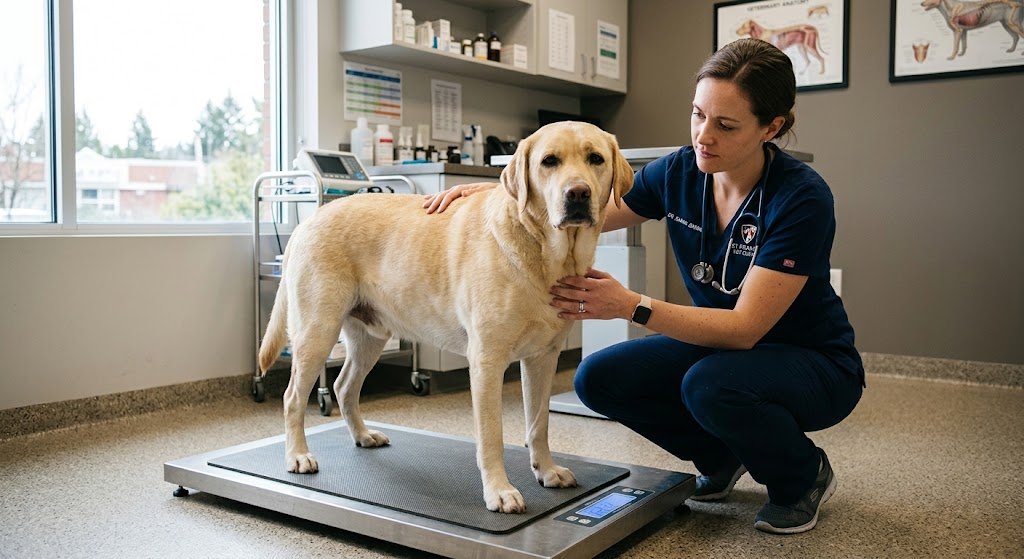
The main information needed for an RER calculation is your dog’s current body weight. Enter the weight as accurately as possible, because the calculated RER changes as body weight changes.
If your dog’s weight is measured in pounds, convert it to kilograms before applying the standard formula.
Convert Pounds to Kilograms
The standard RER formula uses kilograms rather than pounds.
Use this conversion:
Body weight (kg) = body weight (lb) ÷ 2.20462
For example, a dog weighing 22.05 lb is approximately 10 kg:
22.05 ÷ 2.20462 ≈ 10 kg
Once the weight is converted, it can be entered into the RER equation.
Apply the RER Formula
After obtaining the weight in kilograms, use:
RER = 70 × (body weight in kg)^0.75
For a 10 kg dog:
RER = 70 × (10)^0.75
RER ≈ 394 kcal/day
The calculator performs these mathematical steps automatically and displays the estimated result.
Read the Result in kcal/day
The result represents the dog’s estimated Resting Energy Requirement in kilocalories per day.
For example:
| Dog’s weight | Estimated RER |
|---|---|
| 5 kg | ~234 kcal/day |
| 10 kg | ~394 kcal/day |
| 20 kg | ~662 kcal/day |
These figures are mathematical estimates based on the standard RER equation. They should not be interpreted as guaranteed daily feeding amounts because actual energy requirements vary between individual dogs.
Summary
The calculator works by taking body weight, converting it to kilograms when necessary, applying the standard RER formula, and reporting the estimated resting energy requirement in kcal/day.
Keypoints
- Enter your dog’s body weight accurately.
- Convert pounds to kilograms before using the standard formula.
- Use RER = 70 × (kg)^0.75.
- RER is reported in kcal/day.
- Calculator results are estimates, not individualized feeding prescriptions.
Dog RER Calculator Examples
Example for a 5 kg Dog
Using the standard formula:
RER = 70 × (body weight in kg)^0.75
For a 5 kg dog:
RER = 70 × (5)^0.75
RER ≈ 234 kcal/day
So, the estimated RER for a 5 kg dog is approximately 234 kcal/day.
Example for a 10 kg Dog
For a 10 kg dog:
RER = 70 × (10)^0.75
RER ≈ 394 kcal/day
Therefore, a 10 kg dog has an estimated resting energy requirement of approximately 394 kcal/day.
Example for a 20 kg Dog
For a 20 kg dog:
RER = 70 × (20)^0.75
RER ≈ 662 kcal/day
This means the estimated RER is approximately 662 kcal/day.
| Body weight | Estimated RER |
|---|---|
| 5 kg | 234 kcal/day |
| 10 kg | 394 kcal/day |
| 20 kg | 662 kcal/day |
These examples demonstrate how RER increases with body weight, but the increase is not directly proportional because the formula uses body weight raised to the 0.75 power.
How to Check the Calculation
To verify an RER result manually:
- Confirm the dog’s weight is in kilograms.
- Raise the weight to 0.75.
- Multiply that value by 70.
- Round the final result to a practical whole number of kcal/day.
For example, with a 10 kg dog:
70 × 10^0.75 ≈ 394 kcal/day
The calculator should produce approximately the same result, allowing for minor differences caused by rounding.
Summary
Worked examples make the RER formula easier to understand and verify. A 5 kg dog has an estimated RER of about 234 kcal/day, a 10 kg dog about 394 kcal/day, and a 20 kg dog about 662 kcal/day using the standard formula.
Keypoints
- 5 kg → ~234 kcal/day
- 10 kg → ~394 kcal/day
- 20 kg → ~662 kcal/day
- Use 70 × (kg)^0.75 for these calculations.
- Small rounding differences are normal.
- These numbers represent estimated RER, not automatically the dog’s total daily calorie requirement.
What Does a Dog’s RER Result Mean?
Understanding kcal/day
The RER result tells you the estimated amount of energy, measured in kilocalories per day (kcal/day), associated with a dog’s resting energy requirement.
For example, if the calculator gives an RER of 394 kcal/day, that means the dog’s estimated resting energy requirement is approximately 394 kcal per day under the calculation—not that 394 kcal is necessarily the correct amount of food to provide every day.
RER Is a Baseline, Not a Complete Feeding Recommendation
RER is best understood as a starting point for energy calculations. A dog normally uses energy for activities and physiological processes beyond resting requirements, so its actual daily energy needs may be different.
This is why RER should not automatically be treated as a dog’s maintenance calorie target. Veterinary energy calculations can build on RER to estimate broader daily requirements.
Why Two Dogs With the Same Weight Can Have Different Calorie Needs
Body weight is important for calculating RER, but it does not describe every aspect of a dog’s energy requirements.
Two dogs with the same body weight can have different calorie needs because factors such as age, activity level, reproductive status, body condition, health status, and individual metabolism can influence energy expenditure.
Therefore, the same RER calculation does not guarantee that two dogs of identical weight should receive exactly the same number of calories.
Factors That Can Affect Daily Energy Requirements
When moving from a resting estimate toward a practical feeding plan, consider factors such as:
- Life stage: Puppies have different energy needs from mature dogs.
- Activity: Active dogs generally use more energy than sedentary dogs.
- Reproductive status: Pregnancy and lactation can substantially change energy requirements.
- Body condition: Calorie needs may need to be adjusted according to whether a dog is underweight, at an ideal condition, or overweight.
- Health: Certain medical conditions can affect nutritional and energy requirements.
- Individual variation: Dogs of similar size can still have different energy needs.
The RER calculation therefore provides useful mathematical information, but interpreting it appropriately requires consideration of the individual dog.
Summary
A dog’s RER result represents an estimated resting energy requirement in kcal/day. It is a useful baseline for understanding energy needs, but it should not automatically be considered the dog’s complete daily calorie target.
Keypoints
- RER is expressed in kcal/day.
- RER provides a resting energy baseline.
- It is not automatically the same as a dog’s maintenance calorie requirement.
- Dogs of the same weight can have different practical calorie needs.
- Activity, life stage, reproductive status, body condition, health, and individual variation can affect energy requirements.
RER vs. MER for Dogs
What Is MER?
MER stands for Maintenance Energy Requirement. It refers to the estimated amount of energy a dog needs to support its normal daily requirements, rather than only its resting energy needs.
RER and MER are therefore related but not interchangeable:
- RER provides a resting energy baseline.
- MER accounts for the broader energy requirements associated with maintaining the dog’s normal condition and lifestyle.
How MER Relates to RER
MER calculations can use RER as their starting point. A commonly used approach is to multiply RER by an appropriate factor based on the dog’s circumstances.
For example:
MER = RER × appropriate energy factor
This means a dog with an RER of 394 kcal/day would have a different estimated MER depending on which factor is appropriate for that individual dog.
The factor should not be selected solely from the dog’s weight. Life stage, reproductive status, body condition, activity, and other circumstances can affect the appropriate energy requirement.
Common MER Multipliers
Veterinary references provide different factors for different categories of dogs. Merck Veterinary Manual lists examples such as:
| Dog category | Example factor |
|---|---|
| Intact healthy adult | 1.8 × RER |
| Neutered healthy adult | 1.6 × RER |
| Obesity-prone | 1.4 × RER |
| Healthy puppy under 4 months | 3 × RER |
| Healthy puppy over 4 months | 2 × RER |
These are reference factors, not universal feeding instructions. Individual energy requirements can vary, so the appropriate factor and resulting calorie intake should be interpreted in the context of the individual dog.
Why RER and MER Should Not Be Confused
The key difference is what each number represents.
RER answers:
“How much energy does this calculation estimate for resting requirements?”
MER answers:
“How much energy may be needed to support the dog’s broader maintenance requirements?”
For this reason, someone using a Dog RER calculator should not automatically use the RER result as the dog’s daily food allowance. If the goal is to estimate practical daily calorie requirements, MER and the dog’s individual circumstances need to be considered.
Summary
RER is a resting energy baseline, while MER represents a broader maintenance energy estimate. MER can be calculated from RER using an appropriate factor, but the factor depends on the dog’s individual circumstances.
Keypoints
- RER = Resting Energy Requirement.
- MER = Maintenance Energy Requirement.
- MER can be estimated using RER × an appropriate factor.
- Different dog categories may use different reference factors.
- RER should not automatically be treated as a dog’s complete daily calorie requirement.
- MER factors are estimates and should be interpreted alongside the individual dog’s needs.
How Accurate Is a Dog RER Calculator?
Why RER Is an Estimate
A Dog RER calculator performs a mathematical calculation based primarily on body weight, so the result is useful as an energy estimate rather than an exact measurement of an individual dog’s calorie requirements.
Even when the formula is calculated correctly, the result cannot account for every characteristic that may influence how much energy a particular dog uses.
Individual Dogs Can Need More or Fewer Calories
Dogs with similar body weights can have different energy requirements. Differences in activity, life stage, reproductive status, body condition, health, and individual metabolism can all influence energy needs.
For this reason, a calculated RER should be viewed as a starting point for understanding energy requirements, rather than a fixed number that applies equally to every dog.
Body Condition Matters
Body weight alone does not always tell you whether a dog is at an appropriate condition.
A dog may weigh the same as another dog while having a different amount of lean tissue and body fat. When calorie intake is being evaluated, body condition and changes in body weight over time can therefore provide important context alongside the calculated RER.
Why Calorie Needs May Change Over Time
A dog’s energy requirements are not necessarily constant. They can change as the dog grows, becomes more or less active, gains or loses weight, becomes pregnant or lactating, or develops health-related nutritional needs.
If a dog’s body weight or condition is changing unexpectedly, relying on a calculator alone may not identify the underlying reason. A veterinarian can help determine whether the dog’s feeding plan and nutritional requirements need reassessment.
Summary
A Dog RER calculator can provide a useful and mathematically consistent estimate, but it cannot perfectly predict an individual dog’s actual calorie needs. RER should be interpreted alongside body condition, lifestyle, life stage, health, and changes in weight.
Keypoints
- RER is an estimate, not an exact measurement of individual calorie needs.
- Correctly calculating RER does not guarantee that the result is the dog’s ideal daily calorie intake.
- Dogs of the same weight can have different energy requirements.
- Body condition and weight trends provide important context.
- Energy needs can change throughout a dog’s life.
- Veterinary guidance may be appropriate when a dog’s nutritional needs are affected by health problems or significant changes in weight.

When Should You Ask a Veterinarian About Your Dog’s Calorie Needs?
Puppies and Growing Dogs
Puppies have changing nutritional and energy requirements as they grow. Their calorie needs cannot be determined from RER alone, particularly during periods of rapid growth.
A veterinarian can help assess the puppy’s growth, body condition, diet, and overall nutritional needs and determine whether the feeding plan is appropriate.
Dogs With Obesity or Significant Weight Changes
If a dog is overweight, underweight, or experiencing unexplained weight gain or loss, a calculated RER should not be used by itself to determine a restrictive or weight-management feeding plan.
A veterinarian can assess body condition and help establish an appropriate calorie target while considering the dog’s overall health.
Dogs With Medical Conditions
Illness can change a dog’s nutritional and energy requirements. Dogs with medical conditions may require an individualized nutritional plan rather than relying solely on a standard RER calculation.
If your dog has a diagnosed health problem, persistent appetite changes, or unexplained changes in body weight, discuss its nutritional needs with your veterinarian.
Dogs With Special Nutritional Requirements
Pregnancy, lactation, recovery from illness, and other special circumstances can substantially alter energy and nutritional requirements.
In these situations, the RER result can provide useful background information, but it should not replace professional nutritional guidance.
Monitoring Weight and Body Condition
Even when a calculated calorie target is being used, monitoring your dog’s body weight and body condition over time is important.
If your dog’s condition is moving away from a healthy range, the feeding plan may need to be reassessed. A veterinarian can help determine whether the change is related to calorie intake, activity, health, or another factor.
Summary
A Dog RER calculator is useful for estimating resting energy requirements, but some dogs need individualized nutritional guidance. Veterinary input is particularly important for growing puppies, dogs with significant weight changes, medical conditions, or special nutritional requirements.
Keypoints
- Puppies have changing energy and nutritional needs.
- Dogs with obesity or unexplained weight changes may need individualized calorie planning.
- Medical conditions can alter nutritional requirements.
- Pregnancy and lactation can substantially change energy needs.
- Monitor body weight and body condition rather than relying on a calculated number alone.
- Veterinary guidance is appropriate when a dog’s nutritional needs are complex or changing.
Frequently Asked Questions About Dog RER Calculator
What is RER for a dog?
RER stands for Resting Energy Requirement. It is an estimate of the energy a dog requires at rest and is commonly expressed in kcal/day.
How do you calculate RER in dogs?
The standard formula is:
RER = 70 × (body weight in kg)^0.75
Enter the dog’s weight in kilograms, raise it to the power of 0.75, and multiply the result by 70.
What is the RER formula for dogs?
The commonly used exponential formula is RER = 70 × (kg)^0.75. An alternative linear formula, 30 × kg + 70, can be used for dogs weighing more than 2 kg and less than 45 kg.
Is RER the same as daily calorie needs?
No. RER is a resting energy baseline, not necessarily the dog’s complete daily calorie requirement. A dog’s actual energy needs can be affected by activity, life stage, reproductive status, body condition, health, and other individual factors.
What is the difference between RER and MER?
RER estimates resting energy requirements, while MER estimates broader maintenance energy requirements. MER calculations can use RER as a starting point together with an appropriate energy factor.
Can I calculate RER using pounds?
Yes. Because the standard formula uses kilograms, convert pounds first:
kg = pounds ÷ 2.20462
Then apply the RER formula using the resulting kilogram value.
Does a dog’s age affect RER?
Age does not change the mathematical RER formula itself, but it can affect the dog’s overall energy requirements. Puppies, adults, and senior dogs may have different nutritional needs, so RER should not be used as the only factor when determining daily calorie intake.
Can RER be used for overweight dogs?
RER can provide a useful energy estimate, but it should not automatically be used to create a weight-loss diet. An overweight dog’s calorie target should consider body condition, health, ideal weight, and an appropriate weight-management strategy.
Is a Dog RER calculator accurate?
A calculator can accurately perform the selected mathematical formula, but the resulting RER is still an estimate. Individual dogs can require different amounts of energy, so the calculated value should be interpreted in context.
Should I use RER to decide how much food my dog gets?
Not by itself. RER is a starting point for understanding energy requirements. The appropriate daily calorie intake depends on the individual dog and may require consideration of MER, body condition, activity, life stage, health, and other factors.
Conclusion
A Dog RER calculator provides a practical way to estimate a dog’s Resting Energy Requirement using its body weight. The standard formula, RER = 70 × (body weight in kg)^0.75, gives an estimated resting energy value in kcal/day.
RER is useful as a starting point for understanding canine energy requirements, but it is not automatically the same as a dog’s total daily calorie needs. Factors such as life stage, activity, reproductive status, body condition, health, and individual variation can influence actual energy requirements.
For everyday feeding decisions—especially for puppies, dogs with significant weight changes, medical conditions, or special nutritional needs—the calculated RER should be interpreted alongside the dog’s individual circumstances and, when appropriate, veterinary guidance.
Summary
A Dog RER calculator can quickly estimate resting energy requirements, but the result should be treated as an estimate and not as a universal daily feeding target.
Keypoints
- RER = 70 × (kg)^0.75 is the standard formula used in this article.
- RER represents a resting energy baseline.
- RER and MER are not the same.
- Actual calorie needs vary between individual dogs.
- Use calculated results as a starting point rather than an automatic feeding prescription.
References
- Nutritional Requirements of Small Animals — Merck Veterinary Manual
- Daily Maintenance Energy Requirements for Dogs and Cats — Merck Veterinary Manual
- Calorie Ranges for an Average Healthy Adult Dog in Ideal Body Condition — WSAVA Global Nutrition Committee