What to Do Immediately After Your Dog Gives Birth
A postpartum care guide for dogs helps you understand what your mother dog needs immediately after giving birth. Postpartum care begins as soon as she finishes whelping and focuses on helping her recover while providing a clean, quiet environment where she can rest, eat, drink, and safely nurse her puppies.
The first few hours are important. A mother may be tired and focused on her puppies, but you should still monitor her closely for changes that could indicate a complication.
Key Points
- Give the mother fresh water and nutritious food.
- Keep the whelping area clean, dry, and comfortable.
- Check that she is alert and able to move normally.
- Give her short, supervised bathroom breaks.
- Monitor her appetite, behavior, discharge, and mammary glands.
- Make sure she can comfortably nurse and care for her puppies.
- Seek veterinary help if she develops severe or unusual symptoms.
Check the Mother After Whelping
After delivery, allow the mother to rest with her puppies. She may be exhausted and may spend much of her time lying down and nursing.
Check that she is responsive, breathing normally, and able to stand and walk when needed. If you are unsure whether all puppies have been delivered, contact your Vet or Veterinarian rather than trying to determine the cause yourself.
Provide Fresh Water and Food
Place fresh, clean water close to the mother so she can drink without leaving the puppies for long.
Offer a complete, highly digestible food appropriate for pregnancy or lactation. A nursing dog’s energy requirements can increase substantially as milk production increases.
If she refuses food, do not force her to eat. However, persistent loss of appetite or refusal to drink is more concerning when accompanied by weakness, vomiting, abnormal discharge, or other changes.
Keep the Whelping Area Clean
Replace wet or heavily soiled bedding with clean, dry material. The area should be comfortable and large enough for the mother to lie down and nurse without putting the puppies at unnecessary risk.
Clean the area calmly and avoid excessive disturbance during the first hours after birth.
Give Her Short Bathroom Breaks
A mother dog may be reluctant to leave her puppies after giving birth. Even so, she needs regular opportunities to urinate and defecate.
Take her for a short, supervised bathroom break and return her to the puppies afterward. Keep these trips calm, particularly if she is weak or recovering from a difficult delivery or C-section.
Start Monitoring Her Recovery
Begin checking the mother regularly rather than waiting for obvious illness to appear.
Pay attention to:
- Appetite and water intake
- Energy and behavior
- Vaginal discharge
- Mammary glands
- Ability to walk normally
- Nursing and interaction with puppies
- Signs of pain, weakness, or distress
Some postpartum changes can be normal, but serious changes should never be ignored.
Important: Heavy bleeding, foul-smelling discharge, collapse, seizures, severe weakness, breathing difficulty, or other serious symptoms require prompt veterinary attention.
The Most Important Postpartum Red Flags
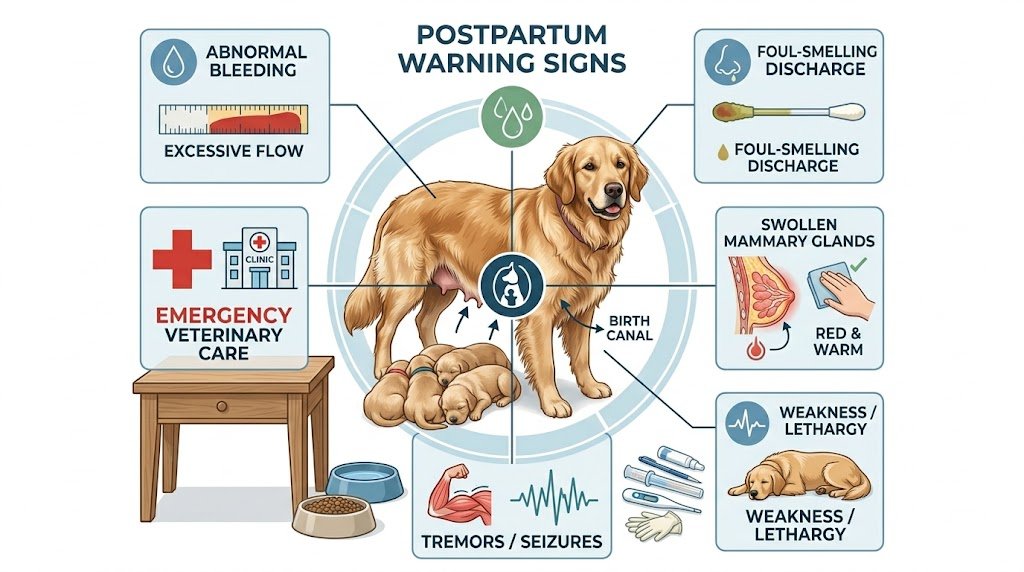
Postpartum red flags are warning signs that a mother dog may be developing a serious complication after giving birth. Some changes are expected after whelping, but certain symptoms require immediate veterinary attention.
The mother should be watched closely during the first hours and days after delivery. If she suddenly becomes very weak, develops severe bleeding, has seizures, or shows other serious changes, do not wait to see if the problem resolves on its own.
Key Points
- Heavy or persistent bleeding is an emergency.
- Foul-smelling or abnormal discharge can indicate infection.
- Hot, swollen, painful mammary glands may indicate mastitis.
- Restlessness, panting, tremors, stiffness, or seizures can be signs of eclampsia (milk fever).
- Collapse, severe weakness, breathing difficulty, or inability to care for the puppies requires urgent veterinary care.
- When in doubt, contact your Vet or emergency veterinarian.
Red Flags That Need Veterinary Attention
| Warning Sign | What It May Mean | What to Do |
|---|---|---|
| Heavy or continuous bleeding | Possible hemorrhage or another postpartum complication | Emergency veterinary care |
| Foul-smelling vaginal discharge | Possible uterine infection such as metritis | Contact a Vet urgently |
| Very weak, collapsed, or unresponsive | Potential serious illness or blood loss | Emergency care |
| Tremors, stiffness, severe restlessness, or seizures | Possible eclampsia or dangerously low calcium | Emergency care |
| Hot, swollen, red, or painful mammary gland | Possible mastitis | Veterinary assessment |
| Difficulty breathing | Potential serious systemic problem | Emergency care |
| Persistent vomiting or inability to keep water down | Possible illness or dehydration | Contact a Vet promptly |
| Refusing food with weakness or other symptoms | Possible postpartum complication | Veterinary advice |
| Suddenly refusing to nurse or care for puppies | Pain, illness, or another maternal problem | Contact a Vet |
Abnormal Vaginal Discharge
Some vaginal discharge can occur after birth, but the appearance, amount, and smell matter.
A discharge that becomes foul-smelling, unusually heavy, or is accompanied by fever, lethargy, poor appetite, or worsening illness should be assessed by a Veterinarian.
Do not rely on discharge alone to decide whether the mother is recovering normally. Consider it together with her overall behavior and physical condition.
Signs of Mastitis
Mastitis is inflammation or infection of a mammary gland and can occur in a nursing mother.
Watch for mammary glands that become:
- Hot or unusually warm
- Swollen
- Red or discolored
- Firm or painful
- Associated with abnormal-looking milk
The mother may also become unwell, lose her appetite, or become unusually tired. These signs warrant veterinary assessment.
Signs of Eclampsia or Milk Fever
Eclampsia is a potentially life-threatening condition associated with low blood calcium, often during heavy lactation.
Early signs can include restlessness, excessive panting, weakness, stiffness, or muscle tremors. Severe cases can progress to seizures.
If a nursing dog develops tremors, severe stiffness, seizures, collapse, or rapidly worsening weakness, treat it as an emergency and contact an emergency veterinarian immediately.
Do not give calcium supplements or other treatments on your own unless your Veterinarian specifically recommends them.
Feeding the Mother After Giving Birth
A nursing mother dog needs more calories, protein, nutrients, and water than a non-lactating adult dog because her body is producing milk for the puppies. Her nutritional needs increase as the puppies grow and milk production reaches its peak. Depending on litter size, lactating dogs may require around 2–4 times their normal maintenance energy intake.
Key Points
- Feed a complete and balanced diet designed for growth, pregnancy, or lactation.
- Keep fresh water available at all times.
- Energy needs can reach about 3 times maintenance at peak lactation and may be higher with larger litters.
- Let the mother eat enough to maintain healthy body condition rather than restricting food.
- Avoid adding calcium or other supplements unless a Veterinarian recommends them.
- Monitor her body condition throughout nursing because excessive weight loss can indicate that her nutritional intake is not keeping up with demand.
How Much Should a Nursing Dog Eat?
There is no single amount that works for every nursing dog. Her needs depend on her body size, litter size, stage of lactation, body condition, and the energy density of her food.
During peak lactation, energy requirements can become several times higher than maintenance. Veterinary nutrition guidance recommends feeding a complete, balanced growth diet freely during lactation so the mother can consume enough energy.
What Should You Feed a Lactating Dog?
Choose a high-quality, complete and balanced food formulated for growth and reproduction/lactation.
These diets provide concentrated nutrition in a relatively small amount of food, which is useful when a mother has high energy demands but limited stomach capacity.
Avoid relying on homemade meat-only diets or unbalanced foods. A complete commercial diet can provide the calcium, phosphorus, protein, fat, and other nutrients needed during lactation.
How Often Should a Nursing Dog Eat?
Some mothers prefer several meals throughout the day, while others can comfortably eat larger amounts. During heavy lactation, free-choice or ad lib feeding may help meet increased energy requirements when using an appropriate complete diet.
Keep her food close to the whelping area so she does not have to leave the puppies for long periods to eat.
Why Water Is So Important
Milk production requires substantial fluid, so water should always be easily accessible.
Keep a clean water bowl near the mother and refill it regularly. Increased thirst can be expected during lactation, but refusing water, repeated vomiting, or signs of dehydration should prompt veterinary advice.
Should You Give Calcium Supplements?
Do not routinely give calcium supplements simply because your dog is nursing.
A complete and balanced diet should normally provide the nutrients required for lactation. Unnecessary calcium supplementation can interfere with normal calcium regulation and may increase the risk of eclampsia in some circumstances.
A Veterinarian may recommend calcium in specific situations, particularly when treating or preventing a documented calcium-related problem. Never use calcium supplements as a substitute for veterinary assessment when a nursing dog develops tremors, stiffness, restlessness, weakness, or seizures.
How to Monitor a Mother Dog After Whelping
Monitoring a mother dog after whelping means checking her physical condition, behavior, milk production, and recovery each day. Regular observation helps you notice small changes early, before a postpartum problem becomes more serious.
Veterinary guidance recommends monitoring the mother’s temperature, vaginal discharge, milk, appetite, mammary glands, and maternal behavior during the postpartum period.
Key Points
- Check her appetite and water intake every day.
- Observe her vaginal discharge for changes in amount, color, or smell.
- Check the mammary glands for redness, swelling, heat, hardness, or pain.
- Monitor her energy level and normal behavior.
- Watch whether she is producing enough milk and allowing the puppies to nurse.
- Take her temperature only when appropriate and follow your Veterinarian’s guidance, especially after a C-section.
- Monitor the puppies too, because poor weight gain can sometimes indicate a problem with maternal care or milk production.
Monitor Her Appetite and Water Intake
A mother dog may have changes in appetite immediately after giving birth, particularly after a difficult labor. However, she should have easy access to food and fresh water.
Continue watching her eating and drinking over the following days. A persistent loss of appetite, poor drinking, vomiting, or increasing weakness should not be ignored, especially when other abnormal signs are present.
Check Vaginal Discharge
Vaginal discharge, known as lochia, is expected after whelping. Merck Veterinary Manual describes normal lochia as dark red to black, odorless, and heavier during the first few days.
The important point is to watch for a change in her overall condition. Discharge that becomes foul-smelling, unusually heavy, or occurs alongside fever, lethargy, reduced appetite, or poor milk production needs veterinary assessment.
Check the Mammary Glands
Examine the mammary glands gently each day. They should not become unusually hot, swollen, hard, red, or painful.
Also watch the milk. Abnormal-colored milk or a sudden reduction in milk production can be associated with mammary or systemic problems and should be discussed with your Veterinarian.
Watch Her Energy and Behavior
A mother dog will naturally spend a lot of time resting and nursing. What matters is whether her condition is generally stable or getting worse.
Watch for sudden lethargy, unusual restlessness, weakness, confusion, difficulty walking, or reluctance to care for the puppies. These changes can accompany postpartum complications and warrant veterinary advice.
Monitor Milk Production and Nursing
The puppies provide useful clues about the mother’s lactation. Healthy newborn puppies should stay warm, nurse regularly, and show appropriate weight gain.
Merck recommends weighing newborn puppies after they are dry and then twice daily during the first week. Weight loss after the first 24 hours or failure to gain appropriately requires prompt attention.
A mother who has inadequate milk production should be evaluated for possible causes such as mastitis, metritis, eclampsia, dehydration, nutritional problems, or pain.
Monitor Temperature Carefully
Body temperature can provide useful information, but a single reading should not be interpreted in isolation.
After delivery, temperature can temporarily rise. For example, VCA notes that after a C-section, a mother dog’s temperature may increase by about 1–2°F (0.5–1°C) during the first 1–3 days before returning toward normal.
When checking temperature at home, follow the method and thresholds recommended by your Veterinarian rather than relying on one number to diagnose an infection.
Keep a Simple Daily Record
A simple record can make changes easier to spot and gives your Vet useful information if you need to call.
Record:
Food → Water → Temperature → Discharge → Mammary glands → Energy → Nursing → Puppy weights

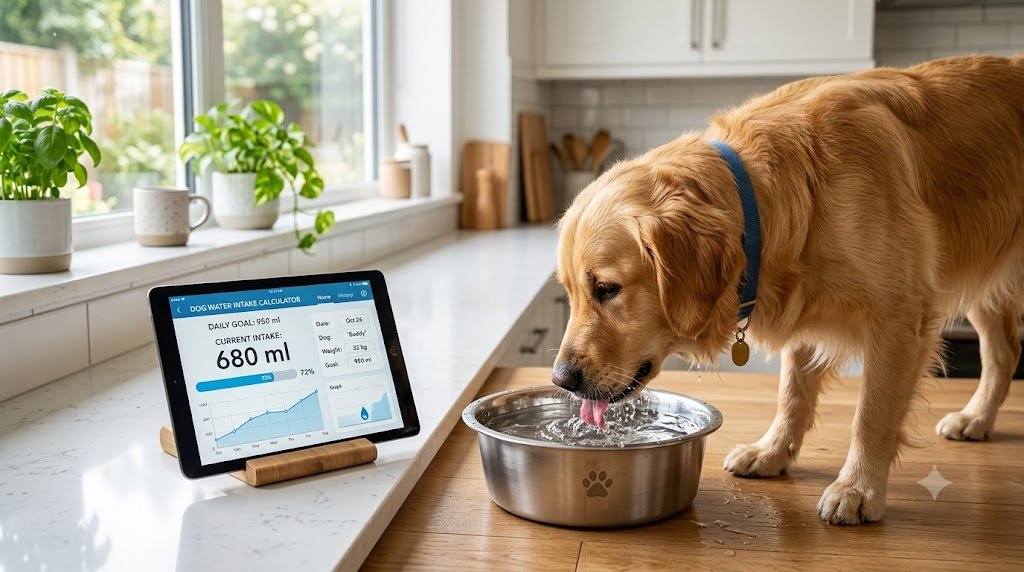
This takes only a few minutes but can help you recognize when the mother or puppies are moving away from a normal recovery pattern.
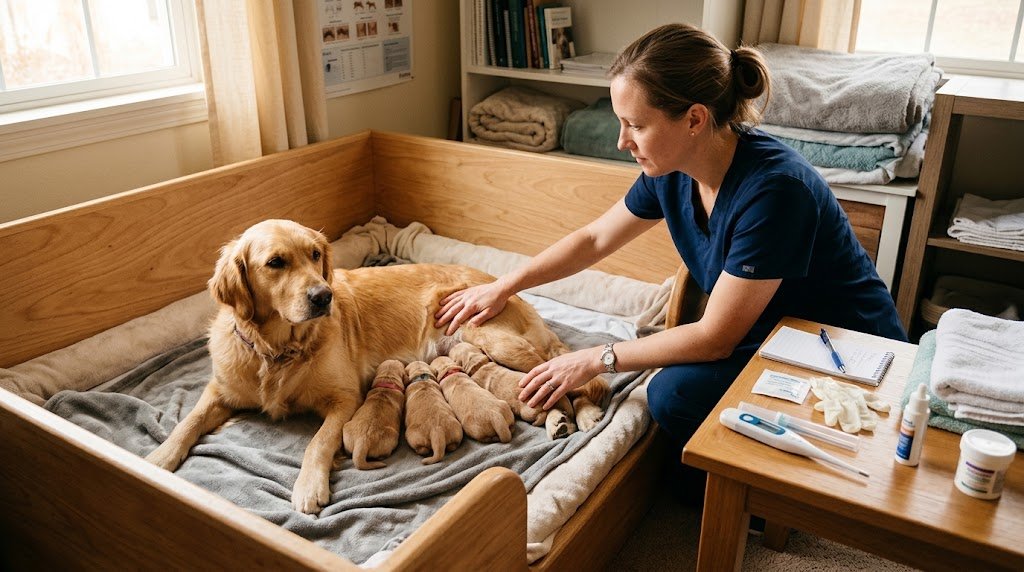
Week 1–4 Postpartum Timeline
The first four weeks after giving birth are a major transition for a mother dog and her puppies. The mother is recovering from whelping while producing milk, and the puppies gradually move from complete dependence on her toward early weaning.
Her nutritional demands are especially high during the middle of this period. VCA notes that a mother dog’s highest energy needs typically occur around 3–5 weeks after whelping, when she may need about 2–4 times the calories of a healthy adult dog.
Key Points
- Week 1: Focus on recovery, nursing, hydration, cleanliness, and close monitoring.
- Week 2: Continue monitoring the mother while puppies remain heavily dependent on nursing.
- Week 3: Puppies become more active and can begin showing interest in solid food.
- Week 4: Early weaning may begin, while the mother still needs substantial nutrition.
- Monitor both the mother and puppies throughout all four weeks.
Week 1: Recovery and Intensive Nursing
The first week is mainly about rest, milk production, and close observation. The mother will usually spend much of her time with the litter while the puppies nurse frequently.
Check her appetite, water intake, discharge, mammary glands, energy, and behavior every day. Newborn puppies should also be weighed regularly because poor weight gain can be an early sign that something needs attention. Merck Veterinary Manual recommends weighing puppies after they are dry and then twice daily during the first week.
Keep the whelping area clean and dry, while minimizing unnecessary disturbance.
Week 2: Continue Close Monitoring
During the second week, the mother is still providing most of the puppies’ nutrition through her milk.
Continue the same basic monitoring routine. She should have constant access to water and an appropriate high-energy diet, while you continue checking her mammary glands and postpartum discharge.
Puppies remain highly dependent on their mother at this stage, so changes in nursing behavior, puppy weight, or the mother’s willingness to care for them deserve attention.
Week 3: Increasing Activity and Early Weaning
Around 3 weeks of age, puppies begin becoming more active and can start showing interest in solid food. Their dependence on nursing gradually begins to decrease.
The mother may also start spending more time away from the litter. This is a normal part of the transition toward greater puppy independence.
Her energy requirements can still be extremely high during this period. VCA identifies approximately 3–5 weeks after whelping as the peak energy-demand period for many nursing dogs.
Week 4: Early Transition Toward Weaning
By about four weeks, puppies can begin transitioning gradually toward solid puppy food while continuing to nurse. Weaning should be gradual, not an abrupt separation from the mother.
As puppies consume more solid food, their nursing gradually decreases. This also helps the mother’s milk production decline naturally.
Continue monitoring the mother’s body condition and mammary glands during this transition. A sudden reduction in nursing or rapid changes in milk production can contribute to mammary discomfort, so gradual weaning is preferable.
Week 1–4 Postpartum Timeline at a Glance
| Postpartum Period | Mother Dog | Puppies | Main Owner Focus |
|---|---|---|---|
| Week 1 | Recovering and heavily nursing | Completely dependent on mother | Monitor health, nursing, weight, hygiene |
| Week 2 | Continued lactation and recovery | Still primarily nursing | Continue daily maternal and puppy checks |
| Week 3 | Very high energy demand | More active; may start solid food | Support nutrition and begin observing weaning |
| Week 4 | Still lactating but milk demand begins changing | Early weaning can begin | Gradually introduce solid food and monitor mother |
Important: This timeline is a general guide, not a rigid schedule. Litter size, the mother’s health, breed, delivery complications, and puppy development can all change the pace of recovery and weaning. A Veterinarian should guide care when the mother or puppies are not progressing normally.
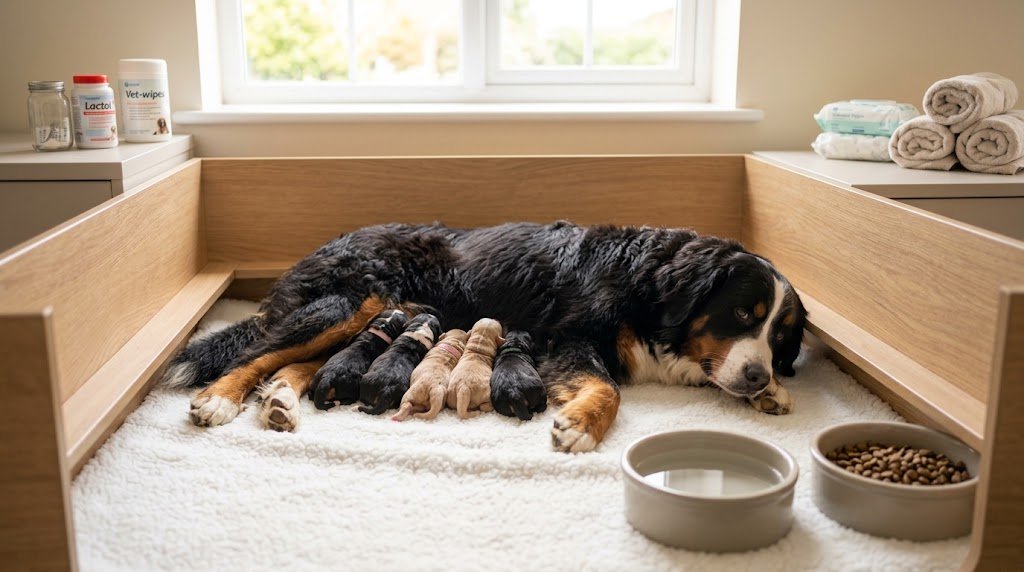
Common Postpartum Complications in Mother Dogs
Postpartum complications are health problems that can develop in a mother dog after whelping. Some require routine veterinary treatment, while others can become life-threatening if treatment is delayed.
The most important complications to recognize are mastitis, metritis, and eclampsia. Other problems, including significant bleeding or inadequate milk production, can also require veterinary assessment.
Key Points
- Mastitis affects the mammary glands and can cause painful swelling, heat, redness, or abnormal milk.
- Metritis is a uterine infection that can cause foul-smelling discharge, fever, lethargy, and poor appetite.
- Eclampsia is a potentially life-threatening drop in blood calcium, often occurring during heavy lactation.
- Significant postpartum bleeding requires veterinary attention.
- Poor milk production should be investigated rather than assumed to be normal.
- Severe symptoms such as collapse, seizures, or marked weakness require emergency veterinary care.
Mastitis
Mastitis is an inflammation or infection of one or more mammary glands. It is most commonly seen in lactating mother dogs and can become serious, including progressing to systemic infection.
Check the mammary glands regularly for:
- Redness or unusual discoloration
- Swelling or firmness
- Heat
- Pain or sensitivity
- Abnormal-looking milk
- Reduced milk production
A mother with mastitis may also become lethargic, lose her appetite, or show other signs of illness. Contact your Veterinarian if you notice these changes.
Metritis
Metritis is an infection of the uterus after pregnancy. It can occur after difficult delivery or when abnormal tissue remains in the uterus, although retained placentas do not always lead to infection.
Possible signs include:
- Foul-smelling vaginal discharge
- Fever
- Low energy or depression
- Reduced appetite
- Vomiting
- Reduced or absent milk production
- Reduced interest in the puppies
These signs need prompt veterinary assessment because metritis can become a serious systemic infection.
Eclampsia or Milk Fever
Eclampsia, also called puerperal hypocalcemia or milk fever, is a life-threatening condition caused by dangerously low blood calcium. It commonly develops during peak milk production, often around 2–3 weeks after whelping, although it can occur at other times during lactation.
Early signs may include:
- Restlessness
- Excessive panting
- Stiff movement
- Weakness or wobbliness
- Muscle twitching
- Spasms
Without treatment, eclampsia can progress to seizures and collapse. This is an emergency requiring immediate veterinary care.
Significant Postpartum Bleeding
Some postpartum discharge is expected, but heavy or persistent bleeding is not something to ignore.
Major postpartum uterine hemorrhage is uncommon but can cause serious blood loss and requires veterinary intervention.
Do not wait for the bleeding to stop on its own if the mother appears weak, pale, collapsed, or otherwise unwell.
Inadequate Milk Production
Insufficient milk production, known as agalactia, is uncommon in dogs but can occur with conditions such as metritis, mastitis, eclampsia, dehydration, nutritional problems, or significant pain.
One useful way to assess whether the puppies are receiving enough milk is to monitor their weight. Puppies that settle after nursing and continue gaining weight are generally a good indication that milk intake is adequate.
If puppies are repeatedly crying, failing to gain weight, or appearing weak, the mother and litter should be evaluated by a Veterinarian.
Important: Never treat suspected eclampsia, mastitis, or metritis at home with leftover medications or supplements. These conditions can look similar to other postpartum problems, and the appropriate treatment depends on the underlying cause.
Final Postpartum Care Checklist and Recovery
A mother dog usually needs continued monitoring for several weeks after whelping, not just during the first day. Her food, water, mammary glands, discharge, body condition, behavior, and ability to care for the puppies should all be watched as lactation continues.
For a smoother recovery:
- Keep her well hydrated and properly fed.
- Maintain a clean, dry whelping area.
- Continue checking her mammary glands and discharge.
- Give her short opportunities to rest away from the puppies.
- Monitor puppy nursing and weight gain.
- Contact your Veterinarian whenever symptoms are unusual, worsening, or severe.
When Should the Mother See a Veterinarian?
A postpartum veterinary check is especially important after a difficult delivery, assisted birth, or C-section. After a C-section, monitor the surgical incision for redness, swelling, discharge, or opening, and follow the discharge instructions provided by your veterinary team.
Do not wait for a scheduled appointment if the mother develops heavy bleeding, foul-smelling discharge, severe weakness, seizures, breathing problems, or other emergency signs.
Track the Puppies’ Age
Knowing the puppies’ exact birth date makes their age easier to track as they move through nursing, development, weaning, veterinary visits, and future vaccination planning.
You can use the Dog Pregnancy Calculator and your recorded whelping date to keep the timeline organized. Vaccination timing should still be confirmed with your Veterinarian because schedules vary by puppy, vaccine, and local veterinary recommendations.
Final Takeaway
Good dog after birth care is mainly about observation, nutrition, hygiene, hydration, and recognizing problems early. A healthy mother should gradually recover while successfully nursing and caring for her litter.
When something looks clearly abnormal, getting veterinary advice early is safer than waiting for the condition to worsen.
Frequently Asked Questions
What should I do after my dog gives birth?
Provide fresh water, nutritious food, clean bedding, and a quiet environment. Monitor her recovery, discharge, mammary glands, appetite, behavior, and nursing closely.
What should I feed my dog after giving birth?
Feed a complete and balanced diet appropriate for growth, pregnancy, or lactation. Her energy requirements can increase substantially while she is nursing.
Is discharge normal after a dog gives birth?
Some postpartum discharge, called lochia, is normal. Normal lochia is generally dark red to black and odorless, but foul-smelling or unusually heavy discharge requires veterinary attention.
What are signs of mastitis in a nursing dog?
Look for mammary glands that become hot, swollen, firm, red, painful, or produce abnormal milk. The mother may also become lethargic or lose her appetite.
What are signs of eclampsia in dogs?
Early signs can include restlessness, excessive panting, stiffness, weakness, and muscle tremors. Seizures or collapse indicate an emergency requiring immediate veterinary care.
When should I call a Veterinarian after my dog gives birth?
Call promptly for heavy bleeding, foul-smelling discharge, severe weakness, collapse, seizures, breathing difficulty, painful mammary glands, or significant changes in the mother’s health or care of the puppies.