A pregnant dog temperature chart is the simplest way to know when labor is close. In the last days of pregnancy, your dog’s body temperature usually falls to about 99°F (37.2°C) or a little lower, and puppies typically start arriving within 8–24 hours of that drop.
This guide gives you the numbers and the context behind them: normal ranges, the pre-labor temperature drop, a daily log you can copy, step-by-step thermometer instructions, the three stages of labor, and the red flags that mean it’s time to call your vet. Keep this pregnant dog temperature chart guide handy now, and keep it open on whelping day.
What Is a Pregnant Dog Temperature Chart?
A pregnant dog temperature chart is a reference guide and daily log for tracking your dog’s rectal temperature during the final stretch of pregnancy. Its job is to catch the natural dip that happens when progesterone falls ahead of labor, so you can predict when whelping (the birth of the puppies) is likely to begin.
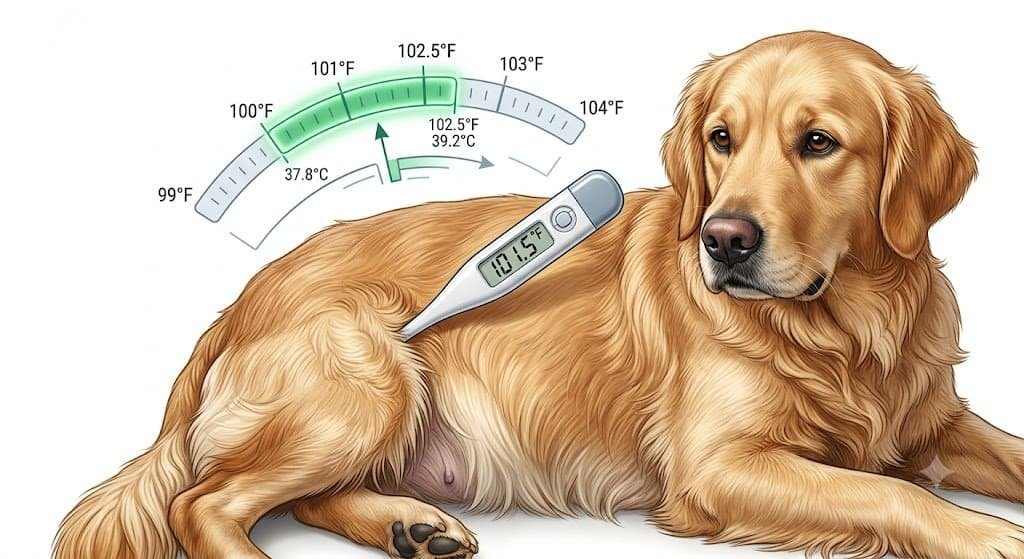
A healthy dog’s rectal temperature normally sits around 100–102.5°F (37.8–39.2°C). In many dogs it drops to roughly 98–99°F (36.7–37.2°C) about 8–24 hours before labor. The timing varies from dog to dog, which is why you watch a trend instead of trusting a single reading.
Temperature and Labor Timeline at a Glance
Here is the pregnant dog temperature chart timeline in five steps:
- Normal pregnancy: around 100–102.5°F (37.8–39.2°C).
- Temperature starts dropping: labor may be approaching, so check more often.
- Around 98–99°F (36.7–37.2°C): labor often begins within roughly 8–24 hours.
- After the drop: watch closely for nesting, restlessness, panting and loss of appetite.
- Active labor: contractions get stronger and the puppies are born.
Common Signs of Labor in Dogs
Read these signs together with your pregnant dog temperature chart:
- Nesting or searching for a quiet, private spot
- Restlessness and frequent changes of position
- Panting or trembling
- Eating less, or refusing food altogether
- Licking the vulva
- Clear or slightly cloudy vaginal discharge
- Visible abdominal contractions
- Strong pushing, followed by the birth of a puppy
Important: temperature alone cannot predict labor to the hour. Call a veterinarian promptly if your dog has strong contractions but no puppy, seems very weak or distressed, has heavy bleeding or foul-smelling discharge, or if anything about the pregnancy worries you.
Why Temperature Monitoring Matters
Of all the early warning signs, a falling temperature is one of the few you can actually measure. A steady pregnant dog temperature chart helps you:
- Spot the pre-labor temperature drop
- Estimate when the puppies may arrive
- Set up the whelping area before you need it
- Recognize abnormal readings that need veterinary attention
- Avoid missing the early stages of labor
When to Start Tracking Temperature
Begin taking your dog’s temperature 7–10 days before her due date. That date is typically 63 days after ovulation, or anywhere from 58 to 68 days after breeding when ovulation wasn’t timed. If you only know the breeding date, start by about day 55.
Not sure of the date? Our dog pregnancy due date calculator gives you an estimate in seconds, and the 63-day dog pregnancy calendar shows what to expect each day.
Fill in your pregnant dog temperature chart at the same time every day. As the due date nears, move to twice daily so you build a reliable baseline and notice any real change.
Summary
A pregnant dog temperature chart records daily body temperature during late pregnancy. Because many dogs show a drop before labor, an accurate chart helps you predict whelping, prepare in time, and recognize when your vet needs to step in.
Keypoints
- A pregnant dog temperature chart tracks body temperature during late pregnancy.
- Most dogs show a noticeable drop before labor begins.
- Start 7–10 days before the expected due date.
- Measure at the same time each day for consistent readings.
- Use it alongside other labor signs, because temperature alone can’t confirm the hour of delivery.
Normal Pregnant Dog Temperature
Normal Body Temperature Range
A healthy pregnant dog’s rectal temperature is generally about 100–102.5°F (37.8–39.2°C), with most dogs settling near 101–102°F. It can wobble a little with activity, stress or the time of day. Small swings are normal and not a reason to worry.
| Temperature (°F) | Temperature (°C) | What it indicates |
| Below 99°F | Below 37.2°C | A clear pre-labor drop if she is near full term. Labor often follows within about 8–24 hours. |
| 99–100.4°F | 37.2–38.0°C | Watch zone. Slightly below normal, so recheck within a few hours and keep monitoring closely. |
| 100.5–102.5°F | 38.1–39.2°C | Normal temperature for most healthy pregnant dogs. |
| Above 102.5°F | Above 39.2°C | Slightly high. Let her rest and recheck. A reading of 103°F (39.4°C) or more, or any fever with other symptoms, needs a vet. |
How Temperature Changes During Pregnancy
For most of pregnancy your dog’s temperature stays steady. In the final days before whelping, progesterone falls, and that usually pulls her temperature down by 1–2°F (0.5–1°C). Many dogs go into labor within the next 8–24 hours, though the exact timing can differ.
After the puppies arrive, her temperature should settle back into the normal range within about a day. Keep checking through that first day so you can catch anything unusual early.
Why Your Dog’s Own Baseline Matters
Every dog has her own normal. One mother may sit at 101.8°F all week, another at 100.9°F. A drop that is obvious for one dog can look small for the other.
That is why veterinary reproduction teams, such as the one at Colorado State University’s teaching hospital, recommend taking readings at the same time each day and at the same point around feeding. One-off, random readings tell you very little. A week of consistent numbers on your pregnant dog temperature chart tells you a lot.
Factors That Affect Body Temperature
Several things can nudge a reading up or down:
- The time of day
- Exercise just before the reading
- Stress or excitement
- Room or outdoor temperature
- Poor thermometer placement or technique
- Underlying illness or infection
Use the same method at about the same time each day to keep your numbers comparable.
Fahrenheit to Celsius Quick Reference
| °F | °C | °F | °C |
| 97.0 | 36.1 | 100.5 | 38.1 |
| 98.0 | 36.7 | 101.0 | 38.3 |
| 99.0 | 37.2 | 102.0 | 38.9 |
| 100.0 | 37.8 | 102.5 | 39.2 |
| 100.4 | 38.0 | 103.0 | 39.4 |
Summary
A normal pregnant dog’s temperature stays around 100–102.5°F (37.8–39.2°C). A drop to about 99°F (37.2°C) or lower near the due date often means labor is approaching, so consistent daily readings on a pregnant dog temperature chart are a key part of whelping preparation.
Keypoints
- Normal is about 100–102.5°F (37.8–39.2°C).
- Small daily fluctuations are common.
- A 1–2°F drop near the due date often comes before labor.
- Many dogs begin labor within 8–24 hours of the drop.
- Learn your own dog’s baseline and compare every reading against it.
Pregnant Dog Temperature Chart by Pregnancy Timeline
Daily Pregnant Dog Temperature Chart
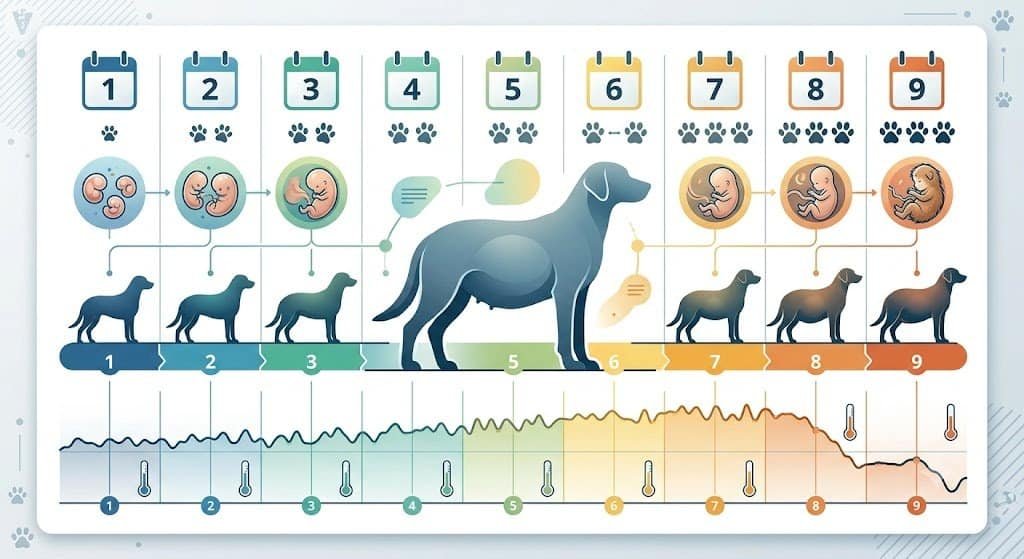
This pregnant dog temperature chart is a general guide to what you may see in the last stretch of pregnancy. Dogs differ, so read it together with the other signs of labor and never as the only indicator.
| Pregnancy stage | Typical temperature (°F) | Typical temperature (°C) | What to expect |
| 7–10 days before due date | 100.5–102.5°F | 38.1–39.2°C | Normal. Begin daily monitoring and set her baseline. |
| 4–6 days before due date | 100.5–102.5°F | 38.1–39.2°C | Keep recording at the same time each day. |
| 2–3 days before due date | 100–102°F | 37.8–38.9°C | Small dips are common. Watch for nesting and appetite changes. |
| 8–24 hours before labor | Below 99°F | Below 37.2°C | The classic drop. Labor is likely close. |
| During labor | Varies | Varies | Temperature can fluctuate as labor progresses. |
| Within 24 hours after birth | 100.5–102.5°F | 38.1–39.2°C | Usually returns to the normal range. |
Printable Pregnant Dog Temperature Chart (Daily Log)
Copy this printable pregnant dog temperature chart into a notebook or spreadsheet, or print the page. Count days from ovulation if you know it. Otherwise count from the first breeding date.
| Day | Date | Morning (°F) | Evening (°F) | Behavior and notes |
| Day 55 | ||||
| Day 56 | ||||
| Day 57 | ||||
| Day 58 | ||||
| Day 59 | ||||
| Day 60 | ||||
| Day 61 | ||||
| Day 62 | ||||
| Day 63 (average due date) | ||||
| Day 64 | ||||
| Day 65 |
In the notes column, jot down appetite, nesting, panting, discharge and anything that seems different. If you’d like the full picture of how she changes before this point, see our week-by-week dog pregnancy guide and the week-by-week pregnancy pictures.
Pregnant Dog Temperature Drop Before Labor
One of the clearest signs that whelping is near is a sudden fall in body temperature. In many dogs it slips from the normal range to below 99°F (37.2°C), roughly 8–24 hours before labor starts. Some dogs only dip to just under 100°F (37.8°C), so a drop of 1–2°F from her own baseline matters as much as the absolute number.
Read the drop together with other pre-labor signs:
- Nesting behavior
- Restlessness
- Reduced appetite
- Panting
- Looking for a quiet place
- Clear vaginal discharge
Expected Temperature Recovery After Birth
Once all the puppies are born, the mother’s temperature normally returns to her usual range within the first day. Keep logging on your pregnant dog temperature chart for the first 24–48 hours so you can spot complications early.
Contact a veterinarian if:
- Her temperature stays at 103°F (39.4°C) or higher
- It stays unusually low after delivery
- A fever comes with lethargy, foul-smelling discharge, poor appetite or trouble caring for the puppies
Summary
A pregnant dog temperature chart helps you track body temperature in the final days before whelping. Most dogs hold a normal temperature until a drop to below 99°F (37.2°C) suggests labor may begin within about 8–24 hours.
Keypoints
- Start the chart 7–10 days before the due date.
- Record once or twice daily at the same time.
- A drop below 99°F (37.2°C) commonly signals impending labor.
- Check other labor signs alongside the numbers.
- Keep checking for 24–48 hours after birth to confirm a normal recovery.
How to Take a Pregnant Dog’s Temperature Correctly
Equipment Needed
The right gear keeps your pregnant dog temperature chart accurate and your dog comfortable.
| Item | Purpose |
| Digital rectal thermometer | Gives the most accurate reading. Keep one just for her. |
| Water-based lubricant | Makes insertion more comfortable. |
| Disposable gloves | Keeps things hygienic. |
| Tissue or paper towel | Cleans the thermometer after use. |
| Notebook or pregnant dog temperature chart | Records every reading so you can see the trend. |
Step-by-Step Process
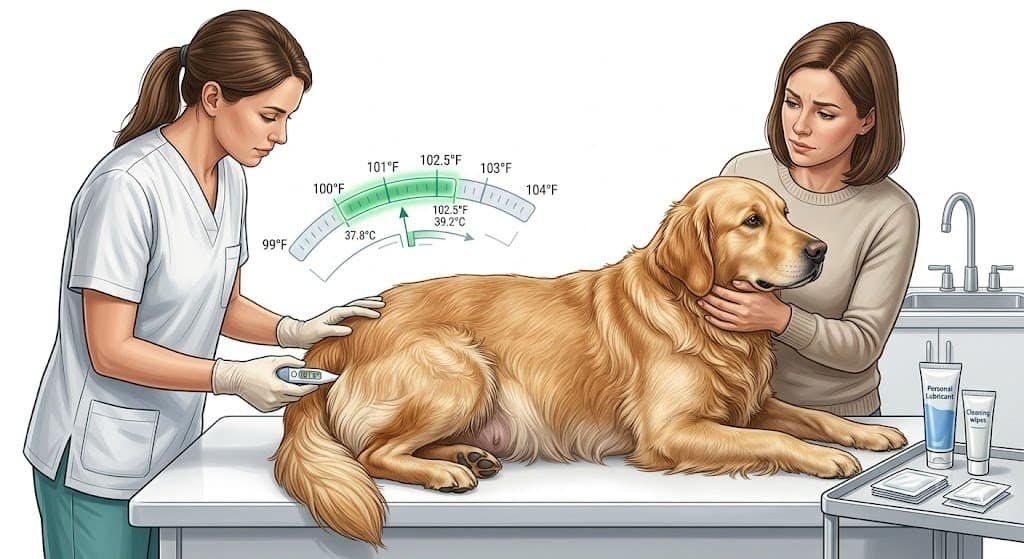
- Wash your hands and put on disposable gloves.
- Add a small amount of lubricant to the thermometer tip.
- Keep your dog calm. Have a helper hold her gently if needed.
- Lift her tail and insert the thermometer about ½–1 inch (1–2.5 cm) into the rectum, depending on her size.
- Wait until the thermometer beeps.
- Write down the temperature, date and time on your pregnant dog temperature chart right away.
- Clean and disinfect the thermometer before storing it.
If she struggles hard or you see blood on the thermometer, stop and call your vet instead of trying again.
Best Time to Measure
Choose a time and stick with it, ideally at the same point in relation to meals. A fixed routine keeps your pregnant dog temperature chart free of the normal ups and downs of the day.
As the due date approaches, many breeders check:
- Once daily during the final week
- Twice daily during the last 2–3 days before the expected delivery
Consistency beats frequency, but don’t go too long between checks. In some dogs the dip is short-lived, and a gap of a day can hide it.
How Often to Check
Here is how often to update your pregnant dog temperature chart as the due date approaches:
| Pregnancy stage | Recommended frequency |
| More than 10 days before due date | Only if your veterinarian advises it. |
| 7–10 days before due date | Once daily. |
| Last 2–3 days before due date | Twice daily at minimum. |
| After a temperature drop | Watch closely for other labor signs and get the whelping area ready. |
Common Measurement Tips
A few habits keep your pregnant dog temperature chart reliable:
- Use the same digital rectal thermometer every time.
- Measure at the same time each day.
- Let her rest for a few minutes before you start.
- Skip readings right after exercise or excitement.
- Record every reading, even the normal ones.
Summary
Taking a pregnant dog’s temperature correctly comes down to a digital rectal thermometer, a steady schedule and careful notes. A well-kept pregnant dog temperature chart makes the pre-labor drop much easier to spot.
Keypoints
- A digital rectal thermometer gives the most accurate readings.
- Measure at the same time every day.
- Begin daily checks 7–10 days before the due date.
- Move to twice-daily checks in the last few days.
- Keep a written pregnant dog temperature chart and look at trends, not single readings.
What Temperature Means Labor Is Near in a Pregnant Dog
Typical Temperature Drop Before Labor
Through most of pregnancy your pregnant dog temperature chart will show about 100–102.5°F (37.8–39.2°C). As labor nears, falling progesterone commonly drops that by 1–2°F (0.5–1°C). Veterinary references describe a typical dip to around 98–99°F, with a range from about 98 to 100°F, in the 8–24 hours before whelping.
The Merck Veterinary Manual puts the average at roughly 98.8°F (37.1°C). Not every dog follows the pattern, so use temperature together with other signs.
| Temperature reading | What it may indicate |
| 100.5–102.5°F (38.1–39.2°C) | Normal late-pregnancy temperature. |
| Around 100°F (37.8°C) | Possible early drop. Recheck soon and look for other labor signs. |
| Below 99°F (37.2°C) | Labor commonly begins within the next 8–24 hours. |
| No drop at all | Some dogs go into normal labor without a noticeable dip. |
How Long After the Temperature Drop Does Labor Begin?
For most dogs, active labor starts within about 24 hours of the drop, often sooner. During that window you may also see:
- Nesting behavior
- Restlessness
- Panting
- Shivering
- Loss of appetite
- Extra clinginess, or a wish to be alone
- Clear vaginal discharge
A falling temperature plus these behaviors is a much stronger signal than either one alone.
Do All Dogs Have a Temperature Drop?
No. Teaching-hospital guidance from Colorado State University notes that roughly 80% of bitches show a pre-whelping drop. That leaves around one in five who don’t, or whose dip is easy to miss.
If your pregnant dog temperature chart stays flat but she is nesting, refusing food and panting, treat her as if labor could start. Your chart is a tool, not a guarantee.
What If Labor Doesn’t Start?
A drop doesn’t promise an immediate delivery. A single low reading that bounces back to normal can also be a false alarm from technique or timing. Recheck, and look for a sustained drop with behavior changes.
Contact a veterinarian if:
- More than 24 hours pass after a clear drop and labor hasn’t begun
- Her temperature stays unusually low with no sign of labor
- She seems weak, distressed or unusually lethargic
- Green or foul-smelling discharge appears before the first puppy
- Strong contractions last 20–30 minutes with no puppy
Summary
On a pregnant dog temperature chart, a reading below 99°F (37.2°C) is one of the most dependable signs that labor is near. Most dogs begin whelping within about 8–24 hours, but you should always read the number alongside her behavior and body signs.
Keypoints
- Normal late-pregnancy temperature is about 100–102.5°F (37.8–39.2°C).
- A drop below 99°F often signals labor within roughly 8–24 hours.
- Roughly 80% of dogs show a clear drop, so a flat chart doesn’t rule out labor.
- Watch nesting, panting, restlessness and appetite along with temperature.
- Call your vet if labor doesn’t progress or emergency signs appear.
Other Signs Your Pregnant Dog Is About to Give Birth
Behavior Changes
In the final 24–48 hours, most dogs start acting differently. These changes usually show up alongside the drop on your pregnant dog temperature chart. Some dogs show them for a day or longer, so don’t be thrown if they appear early.
- Nesting by pulling bedding into a pile
- Pacing and restlessness
- Seeking a quiet, hidden spot
- Staying glued to you
- Hiding from people or other pets
- Losing interest in food
- Licking the vulva
Physical Changes
Her body is also getting ready. Look for:
- Enlarged, swollen mammary glands
- Milk or colostrum leaking from the nipples
- Relaxed pelvic muscles
- A soft, slightly enlarged vulva
- Clear or mucus-like discharge
- Mild abdominal contractions
- A drop in body temperature
These can build over several hours or even a couple of days.
Signs of Stage One Labor
Stage one is the preparation phase. It usually lasts 6–12 hours and can stretch to 24 hours in some dogs, particularly first-time mothers. Expect:
- Panting
- Shivering or trembling
- Restlessness
- Digging and nesting
- Refusing food
- Whining or vocalizing
- Very little sleep
No puppies arrive in this stage. The cervix is opening and the uterus is contracting, even though you can’t see it.
Signs of Active Labor
Stage two begins when contractions become strong and visible and the puppies start to arrive. You will see:
- Strong, regular abdominal contractions
- Straining
- A fluid-filled sac at the vulva
- The first puppy
- A placenta passing after each puppy
- Contractions continuing until the litter is born
If she strains hard for 20–30 minutes without producing a puppy, call a veterinarian right away.
Summary
Most dogs show a mix of behavior and body changes before giving birth. Nesting, panting, restlessness, appetite loss, vaginal discharge and a temperature drop are the most common signals that labor is near, and they work best alongside your pregnant dog temperature chart.
Keypoints
- Behavior changes often appear 24–48 hours before labor.
- Nesting and restlessness are common early signs.
- Milk, a swollen vulva and clear discharge are typical body signs.
- Stage one prepares her body but produces no puppies.
- Strong contractions and straining mean active labor has started.
Stages of Dog Labor
Knowing the stages helps you tell normal from worrying once your pregnant dog temperature chart shows the drop. Labor has three stages, each with its own signs and typical timing.
Stage One: Preparation for Labor
The cervix starts to dilate and her body prepares to deliver. Contractions have begun but usually can’t be seen from outside. This stage typically lasts 6–12 hours and may run up to 24.
- Restlessness and pacing
- Nesting
- Panting
- Shivering or trembling
- Loss of appetite
- Seeking a quiet location
- Body temperature below 99°F (37.2°C)
Stage Two: Puppy Delivery
This is active labor. Visible contractions strengthen and puppies come one at a time. The first puppy usually arrives within 1–2 hours of hard straining. After that, a puppy is commonly born every 30–60 minutes.
A rest of up to about 2 hours between puppies can be normal if she is comfortable and not straining.
- Strong abdominal contractions
- Active straining
- Water sac appearing
- Delivery of each puppy
- Umbilical cord separating
- Contractions continuing until every puppy is born
Stage Three: Placenta Delivery
Stage three is passing the placenta. It alternates with stage two: a puppy arrives, its placenta follows, then the next puppy. Occasionally two puppies are born before both placentas appear.
- A placenta passes after each birth
- Mild contractions continue
- The mother cleans and nurses her puppies
- Normal bonding begins
Count the placentas. A retained placenta can cause infection, so tell your vet if you count fewer placentas than puppies.
Dog Labor Stages Comparison
| Labor stage | Typical duration | Main signs | What happens |
| Stage one | 6–24 hours | Nesting, panting, restlessness, temperature drop | The cervix dilates and the body prepares for birth. |
| Stage two | Several hours, depending on litter size | Strong contractions, straining, puppy delivery | Puppies are born one at a time. |
| Stage three | After each puppy | Mild contractions, placenta passes | Placentas are expelled and nursing begins. |
What Normal Whelping Looks Like
For most healthy dogs, whelping is natural and needs little help. A fluid-filled sac appears first, followed by the puppy. Both head-first and tail-first (breech) births are considered normal in dogs.
The mother tears the sac, licks the puppy to get it breathing, and chews through the cord. Many mothers also eat some or all of the placentas, which is natural, though too many can cause loose stools. A large litter can take from a couple of hours to well over half a day.
Should You Help? What to Do and What to Avoid
For a normal labor, do very little. Stay calm, keep the room quiet and warm, and let her work.
- Do: keep the area calm, limit visitors, and note the time each puppy is born.
- Do: help only if a first-time mother doesn’t open the sac within about a minute. Gently tear it, rub the puppy with a clean towel, and return it to her.
- Don’t: pull on a puppy, tug a cord, or try to speed things up.
- Don’t: wait and hope if you see a red flag. Call your vet.
When a Labor Stage May Be Abnormal
Every dog is different, but call a veterinarian if you notice any of these:
- Stage one lasts longer than 24 hours with no progress
- Strong contractions continue for 20–30 minutes without a puppy
- More than 2 hours pass between puppies while strong contractions continue
- Green or black discharge appears before the first puppy
- She becomes weak, collapses or shows severe distress
Summary
Dog labor happens in three stages: preparation, puppy delivery and placenta delivery. Understanding each one lets you support the mother, track progress and recognize when she needs veterinary help.
Keypoints
- There are three distinct stages of labor.
- Stage one involves cervical dilation and behavior changes.
- Stage two is when puppies are born, usually 30–60 minutes apart.
- Stage three is placenta delivery, which follows each puppy.
- Seek help for prolonged or abnormal labor.
Whelping Kit Checklist
The calmest births are the ones you prepared for a week or two ahead. Gather these before your pregnant dog temperature chart shows a drop.
| Item | Why you need it |
| Whelping box | A clean, warm, draft-free space with low sides. Let her get used to it early, as the American Kennel Club advises. |
| Digital thermometer and lubricant | For your pregnant dog temperature chart readings. |
| Clean towels | To dry and stimulate newborns. |
| Unwaxed dental floss and clean scissors | Only for tying and cutting a cord if the mother doesn’t. |
| Bulb syringe | To clear a newborn’s airway if needed. |
| Heating pad or safe heat source | To keep puppies warm. |
| Small kitchen scale | To weigh each puppy and track growth. |
| Notebook | To keep your pregnant dog temperature chart, birth times and gaps between puppies in one place. |
| Vet and emergency clinic numbers | Saved in your phone and posted where you can see them. |
Book a pre-whelp checkup in the final week. An X-ray at that point counts the puppies so you know how many to expect, which is the best way to tell when labor is truly finished.
Summary
A ready whelping kit and a booked vet checkup remove most of the panic from the big day. Set everything up before the drop shows on your pregnant dog temperature chart, not after it.
Keypoints
- Set up the whelping box 1–2 weeks early.
- Keep the thermometer, towels, bulb syringe and notebook together.
- Save your vet’s and the emergency clinic’s numbers.
- An X-ray in the final week tells you the litter size.
When to Call a Veterinarian
Most dogs give birth without trouble, but some readings on your pregnant dog temperature chart and some symptoms need a vet right away. Spotting them early protects the mother and her puppies.
Dangerous Readings on Your Pregnant Dog Temperature Chart
| Temperature | Possible concern | Recommended action |
| Below 99°F (37.2°C) near the due date | Normal pre-labor drop | Monitor closely. Labor often follows within 8–24 hours. |
| Below 99°F for more than 24 hours with no labor | Possible delay or distress | Call your vet. |
| 103°F (39.4°C) or higher | Fever or infection | Contact a vet, especially if it persists. |
| Persistently low after delivery | Possible postpartum complication | Seek veterinary evaluation promptly. |
| Rapid, unexplained swings | Possible underlying health issue | Monitor symptoms and consult a vet. |
Emergency Labor Symptoms
Get veterinary care immediately if your dog has any of these:
- Strong contractions for 20–30 minutes without a puppy
- More than 2 hours between puppies while she is still straining
- Green or black discharge before the first puppy
- Heavy or continuous bleeding
- Foul-smelling vaginal discharge
- A puppy stuck in the birth canal
- Collapse, weakness or trouble breathing
- Severe pain or extreme distress
- Seizures or loss of consciousness
These can point to dystocia (difficult birth), retained puppies or infection.
Eclampsia (Milk Fever) Warning Signs
Eclampsia is a dangerous drop in blood calcium that can strike around whelping and in early nursing. It is more common in small breeds and in mothers with large litters.
Watch for restlessness, stiffness, muscle tremors, confusion, and eventually collapse or seizures. This is an emergency, so go to a vet immediately instead of waiting to see if she improves.
High-Risk Pregnancies
Some dogs need closer veterinary support during whelping. High-risk situations include:
- First-time mothers
- Dogs carrying a single puppy or a very large litter
- Flat-faced (brachycephalic) breeds such as Bulldogs, Pugs and Boston Terriers
- Dogs with a history of cesarean section or difficult births
- Pregnancies that run well past the due date
- Dogs with underlying medical conditions
Vet-Guided Options: Pre-Whelp X-Ray and Progesterone Testing
If timing is critical, your vet has more precise tools than a thermometer. An X-ray in the last week counts the puppies. Serial progesterone blood tests can also show when labor is pending, and this is especially useful when a planned cesarean is on the table.
According to the Merck Veterinary Manual, labor is pending when progesterone falls below about 2 ng/mL. Ask your vet whether either option makes sense for your dog.
Summary
A pre-labor temperature drop is expected, but persistent fever, abnormal discharge, prolonged labor or signs of distress need prompt veterinary care. When in doubt, call.
Keypoints
- A temperature below 99°F near the due date is usually normal.
- 103°F (39.4°C) or higher may mean infection or illness.
- Call immediately for prolonged straining, heavy bleeding or abnormal discharge.
- Eclampsia and stuck puppies are life-threatening emergencies.
- High-risk dogs benefit from planning with a vet before labor starts.
Common Temperature Monitoring Mistakes
Small errors in technique or timing can give you misleading numbers. These are the pregnant dog temperature chart mistakes to avoid.
Using the Wrong Thermometer
A digital rectal thermometer is the most reliable choice for a pregnant dog temperature chart. Don’t depend on forehead thermometers, non-contact infrared thermometers or human ear thermometers. They can miss the drop entirely.
Checking at Different Times Each Day
Body temperature shifts naturally across the day, so mixed timing makes your pregnant dog temperature chart hard to read. Use the same time, the same thermometer, and write each reading down immediately.
Ignoring Other Labor Signs
Your pregnant dog temperature chart is only one piece of the picture. Some dogs go into labor with no obvious dip, while others show many behavior changes first. Always watch for:
- Nesting
- Panting
- Restlessness
- Loss of appetite
- Clear vaginal discharge
- Visible contractions
Misreading a Temperature Drop
One low number on your pregnant dog temperature chart doesn’t always mean labor is imminent. Movement, poor placement or a faulty thermometer can all skew a reading. If you see an unexpected drop:
- Wait a short while and repeat the reading
- Use the same thermometer to confirm it
- Keep watching for other signs of labor
- Call your vet if anything abnormal develops
Leaving Long Gaps Between Readings
In some dogs the dip lasts only a few hours. Checking once every 24 hours in the final days can miss it completely. Twice daily is the minimum, and many breeders go to every 6–8 hours once the due date arrives, if their vet agrees.
Best Practices for Accurate Monitoring
Follow this routine for a reliable pregnant dog temperature chart:
- Begin 7–10 days before the due date
- Use a digital rectal thermometer
- Measure at the same time each day
- Move to twice-daily checks in the final days
- Keep a written log
- Combine readings with behavior and body observations
Summary
Most monitoring mistakes come from inconsistent timing, the wrong equipment, or leaning on a single reading. A steady routine and close observation give you the most dependable prediction of when your dog will give birth.
Keypoints
- Use a digital rectal thermometer for accurate readings.
- Measure at the same time every day.
- Never rely on temperature alone to predict labor.
- Repeat unexpected readings to confirm them.
- Don’t leave long gaps between checks in the final days.
Conclusion
A pregnant dog temperature chart is one of the most useful tools you have for the final stage of pregnancy. Track her temperature consistently in the last week, and you’ll be able to spot the pre-labor drop and get ready for whelping with time to spare.
Still, even the best pregnant dog temperature chart shouldn’t decide what you do on its own. Keep an eye on nesting, panting, restlessness, contractions and discharge. If you see abnormal temperatures, prolonged labor or any sign of distress, get veterinary help straight away so both the mother and her puppies stay safe.
Frequently Asked Questions
What is the normal temperature for a pregnant dog?
A pregnant dog’s normal rectal temperature is about 100–102.5°F (37.8–39.2°C). Most healthy dogs sit near 101–102°F. Start your pregnant dog temperature chart in the week before her due date to learn her own baseline.
Can a dog go into labor without a temperature drop?
Yes. Many pregnant dogs dip below 99°F (37.2°C) before labor, but not all do. Some start labor with little or no change, so watch behavior and body signs as well.
How long after the temperature drops does a dog give birth?
Most dogs begin labor within about 8–24 hours of a drop below 99°F (37.2°C). If more than 24 hours pass with no labor, or she seems unwell, call your veterinarian.
When should I start taking my pregnant dog’s temperature?
Start your pregnant dog temperature chart once daily about 7–10 days before the expected due date. If you only know the breeding date, begin around day 55. In the last 2–3 days, switch to twice daily at consistent times.
How many times per day should I check my pregnant dog’s temperature?
Once a day in the final week is the minimum. During the last 2–3 days, check at least twice a day. Some breeders check every 6–8 hours once the due date arrives.
What temperature is too low for a pregnant dog?
A reading below 99°F (37.2°C) near the due date is often a normal sign that labor is coming. If it stays low for a long time without labor, or comes with weakness or other worrying symptoms, contact your vet.
How accurate is a pregnant dog temperature chart?
A pregnant dog temperature chart is a helpful monitoring tool but can’t predict the exact hour. It works best alongside nesting, panting, restlessness, contractions and discharge.
Can I use an ear thermometer on my dog?
Pet ear thermometers can give a reading, but a digital rectal thermometer is the most accurate and most recommended method for filling in a pregnant dog temperature chart before labor.
Should I keep taking my dog’s temperature after birth?
Yes, for 24–48 hours after whelping. Her temperature should return to normal. A persistent fever of 103°F (39.4°C) or higher, an unusually low reading, or signs of illness should be checked by a vet.
What should I do if my dog’s temperature drops but labor doesn’t start?
Keep watching for contractions, nesting and other signs. If more than 24 hours pass after a clear drop without labor, or she looks distressed, seek veterinary advice.
Do all dogs have a pre-labor temperature drop?
No. Roughly 80% of dogs show a clear drop before whelping, according to teaching-hospital guidance, so a flat chart doesn’t rule out labor.
Summary
A pregnant dog temperature chart helps you track body temperature in the final days of pregnancy and spot the drop that often comes before labor. Use it with behavior and body signs, take readings correctly, and call your vet when warning signs appear.
Keypoints
- Normal is about 100–102.5°F (37.8–39.2°C).
- A drop below 99°F (37.2°C) often means labor within roughly 8–24 hours.
- Start 7–10 days before the due date with a digital rectal thermometer.
- Fill in your pregnant dog temperature chart at the same time each day.
- Always read temperature alongside other labor signs.
- Contact a veterinarian if labor is prolonged or abnormal symptoms develop.
- Careful monitoring helps you prepare and catch complications early.
This guide is for general education and doesn’t replace advice from your veterinarian. If you are worried about your dog, call your vet or an emergency clinic.
References
- American Kennel Club (AKC) — Dog Pregnancy Care and Preparing for Whelping
- Merck Veterinary Manual — Whelping and Queening in Dogs and Cats
- Colorado State University Veterinary Teaching Hospital — Pregnancy and Whelping
- PetMD — Whelping: A Guide to Help Your Dog Through Labor
- American Veterinary Medical Association (AVMA) — Pet Owner Resources
Planning the whole pregnancy? Try our free dog calculators for due dates, nutrition and more.