A canine whelping calendar helps dog breeders and owners estimate a dog’s expected due date and track important pregnancy milestones. Since the average canine gestation period is about 63 days, a whelping calendar provides a simple way to plan for veterinary visits, prepare a whelping area, and monitor your dog’s pregnancy from breeding to delivery.
While you can manually count the days after mating, a canine whelping calendar makes the process faster and reduces the risk of calculation errors. It’s especially useful for breeders managing planned litters and owners preparing for their dog’s puppies.
In this guide, you’ll learn what a canine whelping calendar is, how it works, its benefits, how to use it correctly, and why an online calculator can provide an even more convenient way to estimate your dog’s due date.
Summary
A canine whelping calendar estimates your dog’s expected delivery date by tracking the pregnancy from the breeding date through the typical 63-day gestation period. It helps you stay organized and prepare for each stage of pregnancy.
Key Points
- A canine whelping calendar estimates your dog’s due date.
- Most canine pregnancies last about 63 days.
- It helps track pregnancy milestones and prepare for whelping.
- Both breeders and dog owners can use a whelping calendar.
- Online calculators make due-date estimation faster and more accurate.
What Is a Canine Whelping Calendar?
A canine whelping calendar is a planning tool that estimates when a pregnant dog is likely to give birth. By using the breeding or mating date as a starting point, it calculates the expected whelping date based on the average canine gestation period of approximately 63 days.
Whether you’re a first-time dog owner or an experienced breeder, a canine whelping calendar helps you stay on schedule throughout your dog’s pregnancy and prepare for the arrival of the puppies.
How Does a Canine Whelping Calendar Work?
A whelping calendar counts forward from the breeding date to estimate your dog’s due date. It also helps you track important pregnancy milestones, including veterinary checkups, fetal development, and the final preparations before labor begins.
Although most pregnancies last around 63 days, the actual delivery date may vary slightly depending on ovulation timing, litter size, and the individual dog.
Who Should Use a Canine Whelping Calendar?
A canine whelping calendar is useful for anyone caring for a pregnant dog, including:
- Dog breeders
- First-time puppy owners
- Kennel operators
- Rescue organizations caring for pregnant dogs
- Veterinary professionals and breeding assistants
Why Is It Useful?
Using a canine whelping calendar makes pregnancy planning easier by helping you:
- Estimate the expected due date.
- Monitor pregnancy progress.
- Schedule veterinary appointments.
- Prepare a whelping area before labor.
- Reduce the chance of missing important pregnancy milestones.
Canine Whelping Calendar at a Glance
| Feature | Purpose |
|---|---|
| Breeding date | Starting point for the pregnancy timeline |
| Estimated due date | Predicts when puppies are likely to be born |
| Pregnancy milestones | Tracks important stages of gestation |
| Whelping preparation | Helps you get ready before labor begins |
Summary
A canine whelping calendar is an easy-to-use planning tool that estimates your dog’s due date and tracks important pregnancy milestones. It helps breeders and owners prepare for whelping with greater confidence and organization.
Key Points
- A canine whelping calendar estimates a dog’s expected delivery date.
- It typically uses the breeding date and a 63-day gestation period.
- The calendar helps track pregnancy milestones from breeding to birth.
- It is valuable for breeders, dog owners, and veterinary professionals.
- Using a whelping calendar improves preparation for labor and puppy care.
How a Canine Whelping Calendar Works
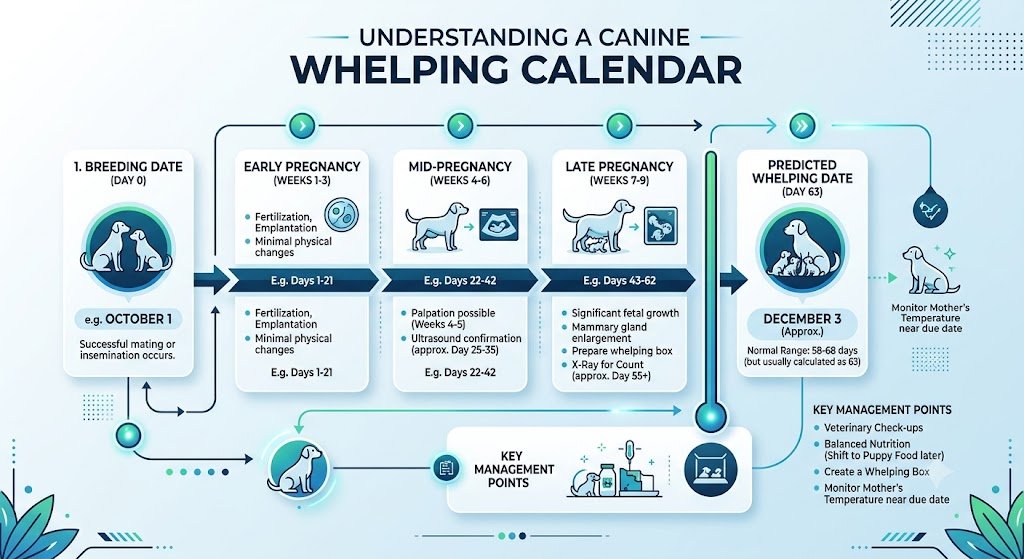
A canine whelping calendar estimates your dog’s expected due date by counting forward from the breeding date. Since the average canine gestation period is about 63 days, the calendar provides a practical timeline to help you monitor pregnancy milestones and prepare for whelping.
While the estimated due date is highly useful, actual delivery may occur a few days earlier or later depending on ovulation timing and individual factors.
Using the Breeding Date
The breeding date is the starting point for most whelping calendars. Once you enter the mating date, the calendar estimates when your dog is likely to give birth.
If the exact ovulation date is known, it generally provides an even more accurate prediction than the breeding date.
Understanding the 63-Day Gestation Period
Most dogs remain pregnant for approximately 63 days from ovulation. However, when counting from the breeding date, a normal pregnancy can range from 58 to 68 days.
This variation is normal because fertilization does not always occur immediately after mating.
Simple Due Date Example
The following example shows how a canine whelping calendar estimates an expected delivery date.
| Breeding Date | Estimated Whelping Date |
|---|---|
| January 5 | Around March 9 |
| April 12 | Around June 14 |
| July 20 | Around September 21 |
| October 1 | Around December 3 |
These dates are estimates and may vary slightly depending on the individual pregnancy.
Why the Due Date Can Vary
Several factors can influence when labor begins, including:
- Ovulation timing
- Litter size
- Breed characteristics
- Age of the mother
- Overall health
Because of these factors, the estimated due date should be used as a planning guide rather than an exact delivery date.
Summary
A canine whelping calendar works by using the breeding date to estimate your dog’s due date based on the average 63-day gestation period. It provides a simple timeline that helps you monitor pregnancy progress and prepare for whelping.
Key Points
- A canine whelping calendar calculates the expected due date from the breeding date.
- Most canine pregnancies last about 63 days.
- Delivery may occur slightly earlier or later than the estimated date.
- Ovulation timing and litter size can affect pregnancy length.
- The calendar serves as a helpful planning tool throughout your dog’s pregnancy.

How to Use a Canine Whelping Calendar
Using a canine whelping calendar is straightforward and helps you stay organized throughout your dog’s pregnancy. By entering the breeding date and following the pregnancy timeline, you can prepare for important milestones and the expected delivery.
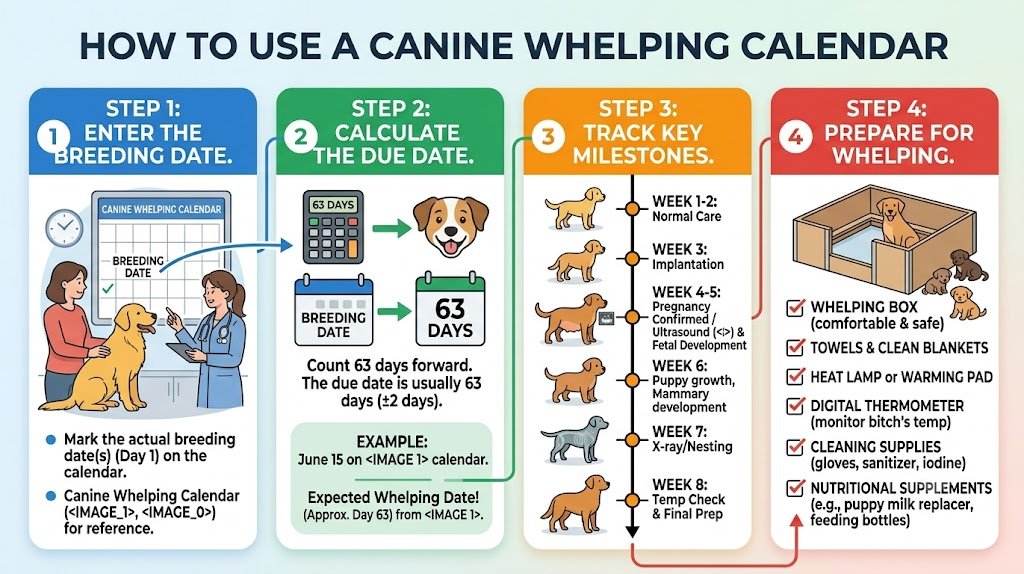
Step 1: Record the Breeding Date
Write down the exact date your dog was bred. This is the starting point for calculating the estimated whelping date. If you know the ovulation date, use it instead for a more accurate prediction.
Step 2: Calculate the Expected Due Date
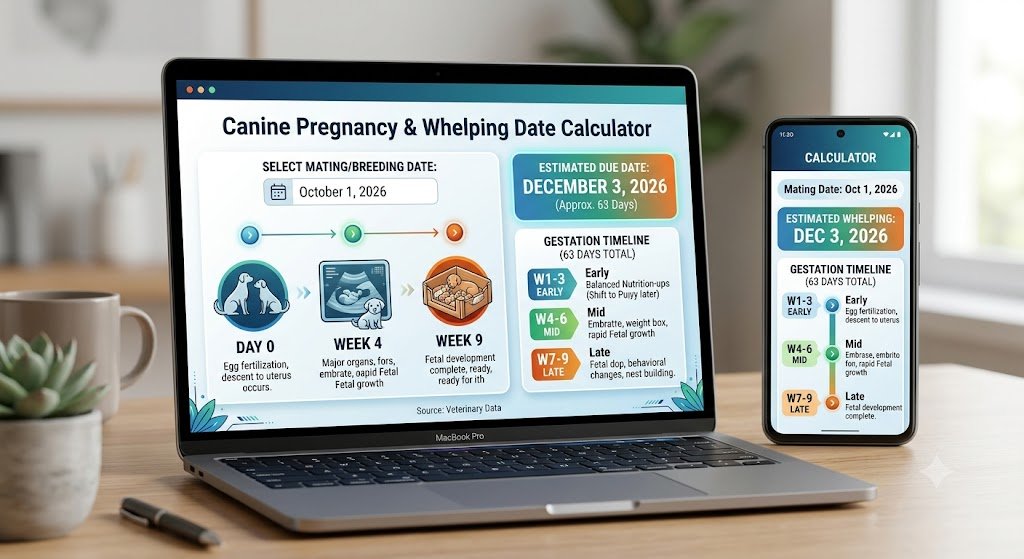
Count approximately 63 days from the breeding or ovulation date. An online canine whelping calendar or dog pregnancy calculator can perform this calculation instantly and reduce the risk of manual errors.
Step 3: Monitor Pregnancy Milestones
As the pregnancy progresses, keep track of important events, including:
- Confirm the pregnancy with your veterinarian.
- Monitor your dog’s weight, appetite, and overall health.
- Watch for physical changes and nesting behavior.
- Prepare for labor as the due date approaches.
Step 4: Prepare for Whelping
A few days before the estimated due date, have everything ready for delivery. Set up a clean whelping area, gather essential supplies, and keep your veterinarian’s contact information easily accessible in case assistance is needed.
Quick Steps at a Glance
| Step | Action |
|---|---|
| 1 | Record the breeding or ovulation date. |
| 2 | Estimate the due date using a canine whelping calendar. |
| 3 | Track pregnancy milestones and your dog’s health. |
| 4 | Prepare the whelping area before labor begins. |
Summary
A canine whelping calendar simplifies pregnancy tracking by helping you estimate the due date, monitor important milestones, and prepare for your dog’s delivery. Following these steps makes it easier to stay organized throughout the pregnancy.
Key Points
- Start with the correct breeding or ovulation date.
- Estimate the due date using a canine whelping calendar.
- Track pregnancy progress from conception to delivery.
- Prepare the whelping area before labor begins.
- Keep regular veterinary appointments throughout the pregnancy.
Benefits of Using a Canine Whelping Calendar
A canine whelping calendar makes it easier to manage your dog’s pregnancy by organizing important dates and helping you prepare for each stage of gestation. Whether you’re breeding dogs professionally or expecting your first litter, it provides a simple way to stay on track.
Estimate the Due Date Accurately
One of the biggest benefits of a canine whelping calendar is estimating your dog’s expected delivery date. Knowing the approximate whelping date allows you to plan ahead and monitor your dog’s progress more confidently.
Track Pregnancy Milestones
A whelping calendar helps you follow important pregnancy stages, including veterinary checkups, fetal development, and the final weeks before labor. Tracking these milestones ensures you don’t miss key events during the pregnancy.
Prepare for Whelping
As the due date approaches, the calendar reminds you to prepare a clean whelping area, gather essential supplies, and watch for signs that labor is beginning.
Plan Veterinary Visits
Using a canine whelping calendar also makes it easier to schedule routine veterinary appointments, pregnancy confirmation, imaging tests, and health evaluations at the appropriate stages of gestation.
Reduce Planning Mistakes
Instead of manually counting days, a whelping calendar provides a structured timeline that reduces calculation errors and helps you stay organized throughout the pregnancy.
Benefits at a Glance
| Benefit | How It Helps |
|---|---|
| Due date estimation | Predicts the expected whelping date |
| Pregnancy tracking | Monitors important milestones |
| Better preparation | Helps organize supplies and the whelping area |
| Veterinary planning | Supports timely health checkups |
| Improved organization | Reduces missed dates and calculation errors |
Summary
A canine whelping calendar helps estimate your dog’s due date, track pregnancy milestones, prepare for delivery, and organize veterinary care. It simplifies pregnancy management and helps ensure you’re ready when whelping begins.
Key Points
- Estimates the expected delivery date.
- Tracks important pregnancy milestones.
- Helps prepare for labor and puppy care.
- Supports timely veterinary visits.
- Makes pregnancy planning simpler and more organized.
Factors That Can Affect the Whelping Date
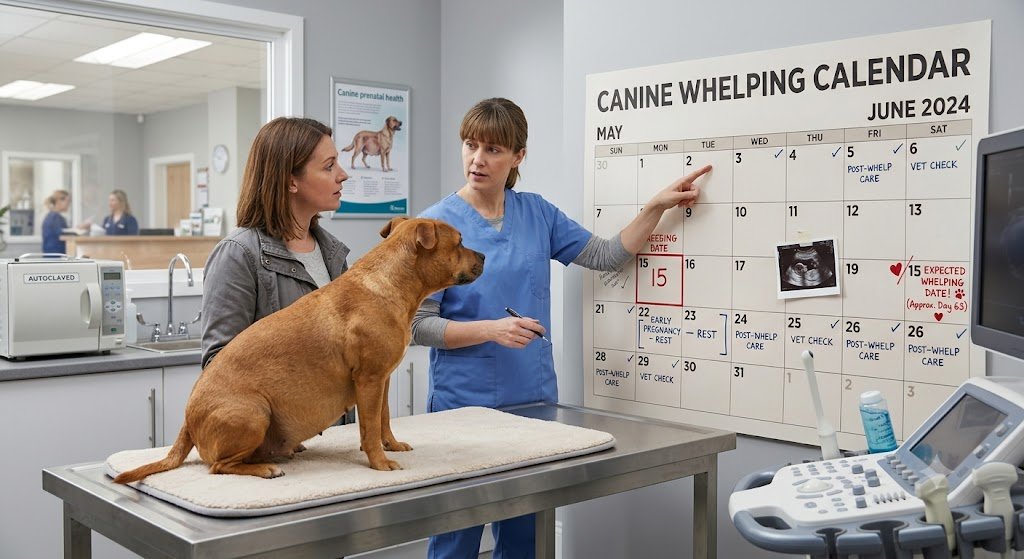
Although a canine whelping calendar provides a reliable estimate, not every dog gives birth on the exact predicted date. Several factors can influence the length of pregnancy and the actual whelping date.
Ovulation Timing
The breeding date and ovulation date are not always the same. Since fertilization may occur several days after mating, the actual due date can differ slightly from the date estimated using the breeding date alone.
Litter Size
The number of puppies can affect when labor begins. Dogs carrying larger litters may whelp slightly earlier, while those carrying smaller litters may remain pregnant a little longer.
Breed and Individual Differences
Most dogs have a similar gestation period, but breed characteristics and individual reproductive differences can cause small variations in pregnancy length.
Mother’s Age and Health
The mother’s age, overall health, and reproductive history can also influence pregnancy and delivery. Regular veterinary checkups help ensure both the mother and puppies remain healthy throughout gestation.
Why the Calendar Is an Estimate
A canine whelping calendar is designed to provide an expected delivery date, not an exact one. Monitoring your dog’s health and watching for signs of labor remain essential as the due date approaches.
Factors Affecting the Whelping Date
| Factor | Possible Effect |
|---|---|
| Ovulation timing | May shift the estimated due date |
| Litter size | Larger litters may arrive slightly earlier |
| Breed differences | Can cause minor variations in gestation |
| Mother’s age | May influence pregnancy and delivery |
| Overall health | Supports a normal pregnancy and healthy whelping |
Summary
While a canine whelping calendar provides an accurate estimate for most pregnancies, factors such as ovulation timing, litter size, breed, age, and overall health can influence the actual whelping date. Monitoring your dog’s pregnancy remains important throughout the gestation period.
Key Points
- A canine whelping calendar estimates, but does not guarantee, the delivery date.
- Ovulation timing is one of the biggest reasons due dates vary.
- Litter size may slightly affect pregnancy length.
- Breed, age, and health can influence when labor begins.
- Continue monitoring your dog as the estimated due date approaches.
Canine Whelping Calendar vs. Dog Pregnancy Calculator
A canine whelping calendar and a dog pregnancy calculator are both designed to estimate your dog’s due date, but they serve slightly different purposes. Understanding how each tool works can help you choose the best option for tracking your dog’s pregnancy.
What Is the Difference?
A canine whelping calendar provides a pregnancy timeline by estimating the expected whelping date from the breeding or ovulation date. It also helps you monitor important milestones throughout the gestation period.
A dog pregnancy calculator focuses on calculating the estimated due date instantly. Many online calculators also display pregnancy progress and expected milestones based on the date you enter.
When Should You Use a Whelping Calendar?
A canine whelping calendar is ideal if you want to:
- Track pregnancy from breeding to delivery.
- Follow important gestation milestones.
- Plan veterinary visits.
- Prepare for whelping in advance.
When Should You Use a Dog Pregnancy Calculator?
A dog pregnancy calculator is best if you want to:
- Calculate the expected due date quickly.
- Avoid manual date calculations.
- Get instant pregnancy estimates.
- Check pregnancy progress at any time.
Comparison Table
| Feature | Canine Whelping Calendar | Dog Pregnancy Calculator |
|---|---|---|
| Estimates due date | ✔ | ✔ |
| Tracks pregnancy timeline | ✔ | ✔ (varies by tool) |
| Calculates instantly | Limited | ✔ |
| Helps plan for whelping | ✔ | ✔ |
| Easy to use online | ✔ | ✔ |
Which Tool Is Better?
For most dog owners and breeders, the two tools work best together. A canine whelping calendar provides a clear pregnancy timeline, while a dog pregnancy calculator offers a fast and convenient way to estimate the due date and monitor pregnancy progress.
Summary
A canine whelping calendar helps you organize your dog’s pregnancy from breeding to delivery, while a dog pregnancy calculator quickly estimates the due date. Using both tools together provides the most complete pregnancy planning experience.
Key Points
- Both tools help estimate your dog’s due date.
- A canine whelping calendar focuses on the full pregnancy timeline.
- A dog pregnancy calculator provides instant due-date estimates.
- Both tools support better pregnancy planning and whelping preparation.
- Combining the two offers the most accurate and organized approach.
Where to Get a Free Canine Whelping Calendar
If you want a quick and reliable way to estimate your dog’s due date, using an online canine whelping calendar is the easiest option. Instead of manually counting days, you simply enter the breeding or ovulation date, and the tool calculates the expected whelping date in seconds.
Why Use DogPregCalc?
DogPregCalc is designed to make pregnancy tracking simple for both dog owners and breeders. Along with estimating the expected due date, it helps you stay on top of important pregnancy milestones so you can prepare for each stage of gestation.
How the Tool Works
Using the free canine whelping calendar only takes a few steps:
- Enter your dog’s breeding or ovulation date.
- Let the calculator estimate the expected whelping date.
- Review the pregnancy timeline and important milestones.
- Prepare for delivery as the due date approaches.
Why Use an Online Whelping Calendar?
An online tool offers several advantages over manual calculations:
- Instant due-date estimates.
- Fewer calculation errors.
- Easy access from any device.
- Convenient pregnancy tracking.
- Better planning for veterinary visits and whelping.
Summary
A free canine whelping calendar simplifies due-date estimation and pregnancy tracking by automatically calculating your dog’s expected delivery date. It saves time, improves accuracy, and helps you prepare for a successful whelping experience.
Key Points
- A canine whelping calendar estimates your dog’s due date in seconds.
- Online tools are faster and more accurate than manual counting.
- The calculator helps track important pregnancy milestones.
- It’s useful for both experienced breeders and first-time dog owners.
- Using a reliable online tool makes pregnancy planning easier.
Use our free canine whelping calendar now → Canine Whelping Calendar
Conclusion
A canine whelping calendar is a simple yet valuable tool for estimating your dog’s due date and tracking each stage of pregnancy. By using the breeding or ovulation date, it helps you plan veterinary visits, monitor important milestones, prepare a whelping area, and stay ready for your dog’s delivery.
While most canine pregnancies last around 63 days, factors such as ovulation timing, litter size, and overall health can influence the actual whelping date. Using a reliable canine whelping calendar alongside regular veterinary care provides the best way to prepare for a healthy pregnancy and successful whelping.
Summary
A canine whelping calendar helps estimate your dog’s expected delivery date, organize pregnancy milestones, and simplify whelping preparation. Combined with proper veterinary care, it makes managing a canine pregnancy easier and more accurate.
Key Points
- A canine whelping calendar estimates your dog’s due date.
- Most dogs have a gestation period of about 63 days.
- Pregnancy timelines help you prepare for every stage of gestation.
- Regular veterinary care remains essential throughout pregnancy.
- Online whelping calendars provide fast and convenient due-date estimates.
Frequently Asked Questions
What is a canine whelping calendar?
A canine whelping calendar is a tool that estimates a dog’s expected due date based on the breeding or ovulation date. It also helps track important pregnancy milestones.
How accurate is a canine whelping calendar?
A canine whelping calendar provides a reliable estimate, but the actual delivery date may vary slightly due to factors such as ovulation timing, litter size, and the mother’s health.
How many days is a dog’s pregnancy?
Most dogs are pregnant for about 63 days from ovulation. When calculated from the breeding date, pregnancy typically lasts 58–68 days.
Should I calculate from the breeding date or ovulation date?
The ovulation date generally provides the most accurate estimate. If it isn’t known, the breeding date is commonly used as the starting point.
Can dogs give birth before 63 days?
Yes. Some dogs may whelp slightly earlier or later than the average gestation period. Premature deliveries should be evaluated by a veterinarian.
Is a dog pregnancy calculator better than a whelping calendar?
Both tools are useful. A canine whelping calendar tracks the pregnancy timeline, while a dog pregnancy calculator provides an instant due-date estimate.
When should I prepare the whelping box?
It’s best to prepare the whelping area about one week before the estimated due date so your dog has time to become comfortable with it.