How to Measure Your Dog for a Crate
Accurate measurements are the best starting point for choosing a dog crate. Your dog should have enough space to stand naturally, turn around, and lie down comfortably without the crate being unnecessarily large.
Measure Your Dog’s Length
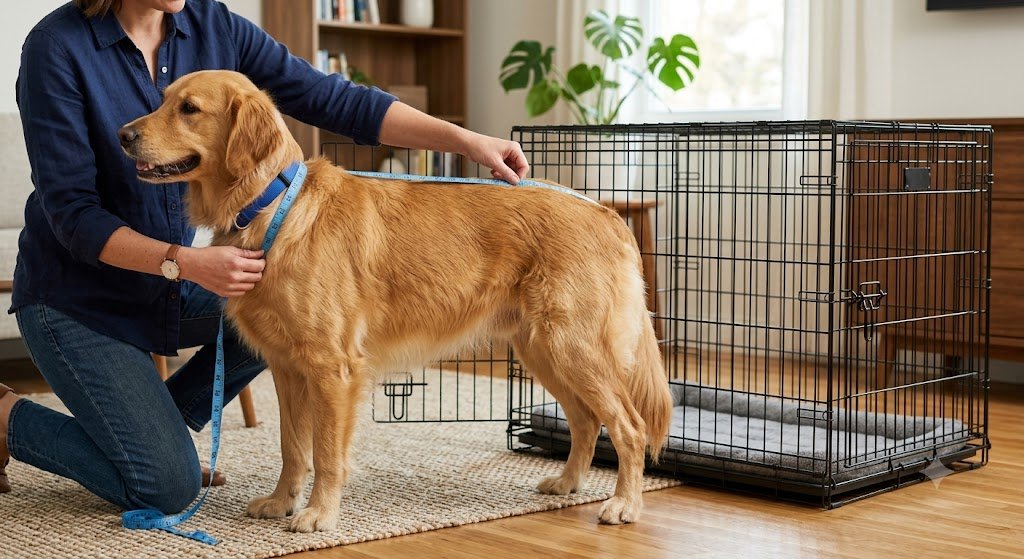
Have your dog stand naturally on all four legs. Measure from the front of the nose to the base of the tail, rather than including the full tail length.
Keep the measuring tape straight along the dog’s body. Record the measurement in inches or centimeters, depending on the unit used by the Dog Crate Size Calculator.
Measure Your Dog’s Height
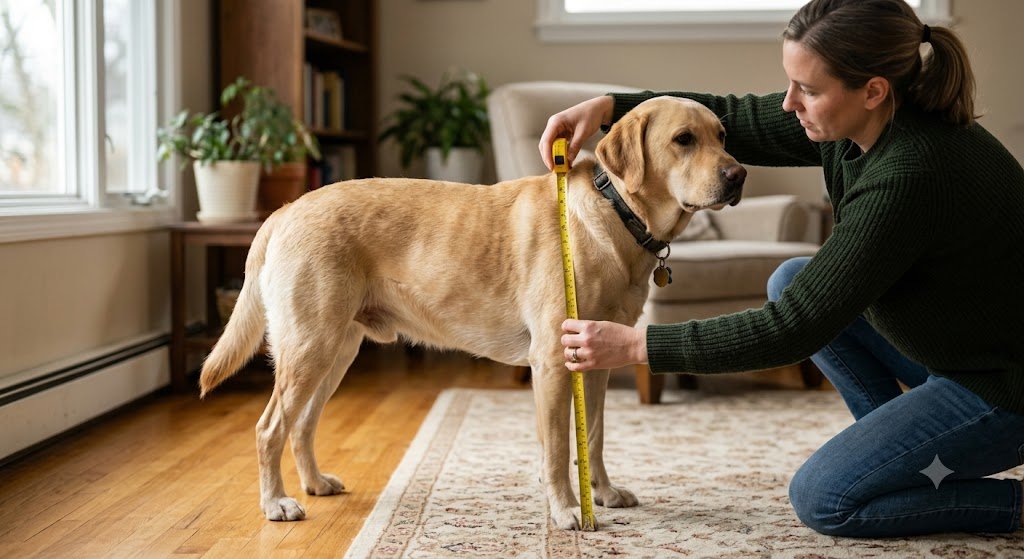
Measure your dog while standing naturally. Take the vertical measurement from the floor to the highest point of the dog’s body according to the calculator’s measurement instructions.
For dogs with naturally upright ears, make sure the measurement method used by the calculator accounts for the dog’s normal standing posture and ear position where relevant.
Check Your Dog’s Width
Width is also important when choosing the final crate. A dog should be able to turn around comfortably without becoming cramped.
If the crate’s interior is narrow compared with your dog’s body, a sufficient length and height alone may not provide a comfortable fit. Always check the crate’s actual interior dimensions, not just its exterior measurements.
Summary
Measure your dog’s body length and standing height accurately before using the calculator. Check width and the crate’s interior dimensions as well to make sure your dog can stand, turn around, and lie down comfortably.
Keypoints
- Measure your dog’s body length from the nose to the base of the tail.
- Measure standing height accurately.
- Consider your dog’s body width when selecting the final crate.
- Use the crate’s interior dimensions, not only its exterior size.
- The goal is enough room for your dog to stand, turn, and lie down comfortably.
How the Dog Crate Size Calculator Works
The Dog Crate Size Calculator estimates suitable crate dimensions from your dog’s measurements. The calculation is intended to provide a practical starting point rather than guarantee that every crate with the same labeled size will fit every dog.
Minimum Crate Length
Your dog’s body length is used to estimate the minimum interior length needed for the crate. The calculation should allow enough additional space for your dog to position itself comfortably without making the crate unnecessarily large.
When checking a crate, compare the calculator’s recommended length with the actual interior length listed by the manufacturer.
Minimum Crate Height
The calculator also considers your dog’s standing height. The crate should provide enough vertical clearance for your dog to stand naturally without being forced to crouch or keep its head lowered.
Check the manufacturer’s interior height because exterior crate dimensions can be larger than the usable space inside.
Choosing the Recommended Crate Size
After entering the measurements, the calculator provides an estimated crate size or minimum dimensions. Use this result to identify a crate whose interior dimensions meet or exceed the calculated requirements.
If a crate falls between two available sizes, compare the actual interior dimensions and choose the option that provides adequate room without excessive unused space. For puppies, consider whether the crate includes a divider that can be adjusted as the dog grows.
Summary
The calculator uses your dog’s measurements to estimate suitable minimum crate dimensions. Treat the result as a sizing guide, then verify the actual interior length, height, and width of the crate before choosing one.
Keypoints
- The calculator provides an estimate, not a guaranteed fit.
- Dog length helps determine the required crate length.
- Standing height helps determine the required crate height.
- Always compare the result with the crate’s interior dimensions.
- Consider adjustable dividers when selecting a crate for a growing puppy.
Dog Crate Size Chart
A dog crate size chart can help you match your dog’s measurements with a general crate category. However, crate sizes are not completely standardized, so the listed size should be treated as a starting point rather than a guarantee of fit.
Standard Crate Sizes
Dog crates are commonly sold in size categories ranging from very small to extra-large. The exact interior dimensions can vary between manufacturers, even when two crates have the same size label.
| Crate Category | General Use | Important Check |
|---|---|---|
| Small | Toy and small dogs | Check interior length and height |
| Medium | Small to medium dogs | Compare with your dog’s measurements |
| Large | Medium to large dogs | Check standing and turning space |
| Extra Large | Large and giant dogs | Verify all three interior dimensions |
Always use the actual interior dimensions when comparing a crate with your calculator result.
Crate Size by Dog Weight
Weight can provide a rough indication of which crate category may be suitable, but it should not be the only sizing factor. Dogs with similar weights can have very different body lengths, heights, and proportions.
For that reason, a measurement-based result from the Dog Crate Size Calculator is more useful than selecting a crate solely from a weight range.
Why Weight Is Only a General Guide
A heavier dog is not necessarily longer or taller than a lighter dog. Body shape also varies considerably between breeds and individual dogs.
Use weight as a secondary reference when a manufacturer provides it, but prioritize your dog’s actual measurements and the crate’s interior dimensions when making the final choice.
Summary
Dog crate size labels and weight ranges provide general guidance, but they do not guarantee the right fit. Use your dog’s measurements and compare the calculator’s recommendation with the crate’s actual interior dimensions.
Keypoints
- Crate size labels can vary between manufacturers.
- Interior dimensions are more useful than size labels alone.
- Weight should be treated as a general reference.
- Dog length and height provide more direct sizing information.
- Always compare the calculator result with the manufacturer’s measurements.
What Size Crate Does My Dog Need?
The right crate size depends on your dog’s actual body measurements, not simply its breed or weight. A properly sized crate should give your dog enough room to stand comfortably, turn around, and lie down naturally without being unnecessarily oversized.
Small Dogs
Small dogs generally need a crate with less interior space than medium or large dogs, but individual body proportions still matter. Measure your dog’s height and length and compare those measurements with the crate’s interior dimensions rather than choosing solely from a small, medium, or large label.
Medium Dogs
Medium-sized dogs can vary considerably in body shape. A long-bodied dog may need a longer crate than another dog of similar weight, while a taller dog may require additional vertical clearance.
Use your dog’s measurements as the primary guide and make sure the crate allows normal standing, turning, and lying positions.
Large Dogs
Large dogs require particular attention to interior dimensions because a crate that appears large from the outside may provide less usable space inside.
Check that your dog can stand without its head touching the roof and can lie down fully without being cramped.
Giant Dogs
For giant or unusually proportioned dogs, standard size labels may be less useful. Compare your dog’s measurements directly with the manufacturer’s listed interior length, height, and width.
If a suitable crate is difficult to find, prioritize the dog’s ability to maintain comfortable natural positions rather than relying on a generic breed-based recommendation. Current guidance also recognizes that there is not enough evidence to define one universally ideal crate size for every dog based on breed, age, or other characteristics.
Summary
There is no single crate size that fits every dog within a breed or weight category. Measure your dog and select a crate that provides adequate room to stand, turn around, and lie down comfortably while checking the manufacturer’s actual interior dimensions.
Keypoints
- Choose a crate based primarily on your dog’s actual measurements.
- Your dog should be able to stand, turn around, and lie down comfortably.
- Breed and weight are only general references.
- Check interior dimensions, not just crate size labels.
- Dogs with unusual proportions may need a crate selected specifically by measurement.
How Big Should a Dog Crate Be?
A dog crate should provide enough space for your dog to stand comfortably, turn around, and lie down naturally. It should not be so large that there is excessive unused space, particularly when the crate is being used during puppy house-training.
Standing Comfortably
Your dog should be able to stand upright without being forced to crouch or press against the top of the crate. When measuring, account for your dog’s normal standing posture and compare the result with the crate’s interior height.
AKC’s current sizing guidance recommends measuring your dog from the top of the head to the bottom of the feet and adding about 3–4 inches to determine the crate height.
Turning Around
Your dog should be able to turn around freely inside the crate. A crate that is technically long enough but too narrow can still be uncomfortable.
Check the usable interior width as well as length and height before making your final selection.
Lying Down Fully
Your dog should be able to lie down comfortably in a natural position. The crate should provide enough space for normal resting without forcing your dog to remain curled tightly.
For general crate sizing, AKC recommends measuring from the tip of the nose to the tip of the tail and adding about 3–4 inches to estimate the required crate length.
Avoid Excessive Extra Space
More space is not automatically better. For puppies, an excessively large crate can provide enough room to sleep in one area and eliminate in another, which can interfere with house-training. An adjustable divider can allow the usable space to increase as the puppy grows.
Summary
The right dog crate should allow comfortable standing, turning, and lying down without providing unnecessary excess space. Use your dog’s measurements to estimate the required dimensions, then verify the crate’s actual interior size before choosing it.
Keypoints
- Your dog should be able to stand, turn around, and lie down comfortably.
- Current AKC guidance suggests adding about 3–4 inches to height and length measurements when estimating crate dimensions.
- Check the crate’s interior width as well as length and height.
- Avoid excessive space, especially for puppies during house-training.
- A divider can make an adult-sized crate practical for a growing puppy.
Puppy Crate Size
Puppies need a crate that is large enough for their current body size while allowing enough room to grow. A properly sized crate should still let the puppy stand, turn around, and lie down comfortably.
Using an Adult-Size Crate With a Divider
A practical option for a growing puppy is an appropriately sized adult crate with a removable divider. The divider limits the usable space while the puppy is small and can be moved as the puppy grows.
This approach can avoid repeatedly replacing the entire crate, provided the crate is suitable for the puppy’s expected adult size and the divider is secure.
Adjusting the Divider as Your Puppy Grows
Re-measure your puppy as it grows rather than moving the divider according to age alone. Increase the usable crate space when the puppy needs more room to stand, turn, and lie down comfortably.
The divider should never make the crate so small that normal movement or resting becomes difficult. At the same time, providing excessive unused space can be undesirable during house-training because a puppy may be able to eliminate away from its sleeping area. (akc.org)
When to Recheck Crate Size
Growth rates vary considerably between puppies. Check the fit whenever your puppy’s body size noticeably changes, particularly if the puppy begins having difficulty standing, turning, or stretching out comfortably.
Use current measurements rather than relying on the crate size that worked a few weeks earlier.
Summary
For growing puppies, an adult-sized crate with a secure adjustable divider can provide a practical solution. Re-measure the puppy as it grows and adjust the divider so the available space remains appropriate.
Keypoints
- Puppies need enough room to stand, turn, and lie down comfortably.
- An adult-size crate with a secure divider can accommodate growth.
- Move the divider as your puppy’s measurements change.
- Do not make the usable space unnecessarily large during house-training.
- Recheck the fit regularly as your puppy grows.
Common Dog Crate Sizing Mistakes
Choosing a crate by a generic size label can result in a poor fit. The most reliable approach is to measure your dog and then verify the crate’s actual interior dimensions.
Choosing by Breed Alone
Breed can provide a general idea of a dog’s eventual size, but individual dogs can have different body proportions. Two dogs of the same breed may need different crate dimensions.
Use your dog’s measurements rather than assuming a crate size based only on breed.
Using Weight as the Only Measurement
Weight does not show how long or tall a dog is. A dog can be relatively heavy with a shorter body or relatively light with a longer body.
Weight can be useful as an additional reference, but length and height should be considered when determining the appropriate crate dimensions.
Buying a Crate That Is Too Small
A crate is too small if your dog cannot stand comfortably, turn around, or lie down naturally. Signs of an undersized crate can include restricted movement or the dog repeatedly touching the sides or top when changing position.
Re-measure your dog and compare the measurements with the crate’s interior dimensions if the fit appears restricted.
Buying an Excessively Large Crate
A crate should not be unnecessarily oversized. This is particularly relevant during puppy house-training, when excessive unused space can allow a puppy to eliminate away from its sleeping area.
For a growing puppy, a properly sized crate with an adjustable divider can provide additional space as the puppy grows without requiring an excessively large usable area from the beginning. (akc.org)
Summary
Common crate-sizing mistakes include relying on breed or weight alone, ignoring actual interior dimensions, choosing a crate that is too small, or providing excessive space for a puppy. Measuring your dog and checking the final fit helps avoid these problems.
Keypoints
- Do not select a crate by breed alone.
- Weight should not be the only sizing measurement.
- A dog must be able to stand, turn, and lie down comfortably.
- Check the crate’s actual interior dimensions.
- Consider an adjustable divider for a growing puppy.
Common Dog Crate Sizing Mistakes
Choosing a crate by a generic size label can result in a poor fit. The most reliable approach is to measure your dog and then verify the crate’s actual interior dimensions.
Choosing by Breed Alone
Breed can provide a general idea of a dog’s eventual size, but individual dogs can have different body proportions. Two dogs of the same breed may need different crate dimensions.
Use your dog’s measurements rather than assuming a crate size based only on breed.
Using Weight as the Only Measurement
Weight does not show how long or tall a dog is. A dog can be relatively heavy with a shorter body or relatively light with a longer body.
Weight can be useful as an additional reference, but length and height should be considered when determining the appropriate crate dimensions.
Buying a Crate That Is Too Small
A crate is too small if your dog cannot stand comfortably, turn around, or lie down naturally. Signs of an undersized crate can include restricted movement or the dog repeatedly touching the sides or top when changing position.
Re-measure your dog and compare the measurements with the crate’s interior dimensions if the fit appears restricted.
Buying an Excessively Large Crate
A crate should not be unnecessarily oversized. This is particularly relevant during puppy house-training, when excessive unused space can allow a puppy to eliminate away from its sleeping area.
For a growing puppy, a properly sized crate with an adjustable divider can provide additional space as the puppy grows without requiring an excessively large usable area from the beginning. (akc.org)
Summary
Common crate-sizing mistakes include relying on breed or weight alone, ignoring actual interior dimensions, choosing a crate that is too small, or providing excessive space for a puppy. Measuring your dog and checking the final fit helps avoid these problems.
Keypoints
- Do not select a crate by breed alone.
- Weight should not be the only sizing measurement.
- A dog must be able to stand, turn, and lie down comfortably.
- Check the crate’s actual interior dimensions.
- Consider an adjustable divider for a growing puppy.
Dog Crate Size Calculator: Quick Answer
The Dog Crate Size Calculator estimates the appropriate crate dimensions using your dog’s measurements. Measure your dog from the nose to the base of the tail for length and from the floor to the top of the head for height, then use those measurements to estimate the minimum interior crate size.
A properly sized crate should give your dog enough room to stand comfortably, turn around, and lie down naturally. As a general sizing guide, current AKC guidance recommends adding about 3–4 inches to the dog’s length and height measurements when estimating the required crate dimensions.
Because crate dimensions and designs vary between manufacturers, always compare the calculator result with the crate’s actual interior dimensions before purchasing.
Summary
Measure your dog’s length and height, use the calculator to estimate the required crate dimensions, and then confirm the final choice using the manufacturer’s interior measurements. The crate should allow comfortable standing, turning, and lying down.
Keypoints
- Measure your dog’s length and height accurately.
- Add approximately 3–4 inches to the length and height measurements as a general sizing guide.
- Check the crate’s interior dimensions before buying.
- Your dog should be able to stand, turn around, and lie down naturally.
- Use breed and weight only as secondary references.
Dog Crate Size Calculator for Travel
A crate suitable for everyday use is not automatically suitable for air travel. If you are choosing a crate for transportation, check the requirements of the specific airline and destination before purchasing because travel requirements can differ from ordinary home-crate sizing.
Home Crate vs. Travel Crate
For home use, the main consideration is whether your dog can stand, turn around, and lie down comfortably. For travel, the crate must also meet the applicable carrier’s requirements for construction, ventilation, security, and dimensions.
Do not assume that a crate size recommended by the calculator automatically meets airline requirements.
Airline Requirements
Airlines can have their own rules for pet carriers, including requirements related to crate construction, ventilation, door security, food and water arrangements, and the amount of space available to the animal.
Before traveling, check the current requirements of the specific airline and any applicable destination regulations. Requirements can change, so information from an old crate-size chart should not be treated as a current travel standard.
Using the Calculator for Travel
The calculator can help you understand the approximate space your dog needs based on its measurements. For an actual trip, use that result only as a starting point and then verify the carrier’s required dimensions and specifications.
If the airline’s requirements conflict with a general calculator recommendation, follow the airline’s current requirements and confirm the crate remains appropriately sized for your dog.
Summary
A Dog Crate Size Calculator can estimate the space your dog needs, but travel crates require additional checks. Always verify the current airline and destination requirements before using a crate for air travel.
Keypoints
- A home crate and a travel crate may have different requirements.
- Airline rules can vary between carriers and routes.
- Check the airline’s current requirements before traveling.
- Do not assume a calculator result guarantees airline compliance.
- Use the calculator as a sizing guide, then verify the actual travel requirements.
Dog Crate Size Calculator: What Measurements Matter Most?
The most useful measurements for estimating crate size are your dog’s body length and standing height. These measurements provide a more direct indication of the interior space your dog needs than breed or body weight alone.
Body Length
Measure from the front of your dog’s nose to the base of the tail while the dog is standing naturally. This measurement helps determine the minimum interior length needed for comfortable positioning.
For a general crate-size estimate, current AKC guidance recommends adding approximately 3–4 inches to the measured length.
Standing Height
Measure from the floor to the top of your dog’s head while standing naturally. This helps determine the minimum interior height.
AKC’s current guidance similarly recommends adding approximately 3–4 inches to the dog’s height measurement when estimating crate height.
Why Weight Is Secondary
Weight can help identify a general crate category, but it does not directly tell you how much interior length or height your dog needs. Dogs with the same weight can have substantially different body proportions.
For that reason, use weight as supporting information and prioritize your dog’s actual measurements when using the calculator.
Summary
Body length and standing height are the key measurements for estimating crate dimensions. Weight and breed can provide additional context, but they should not replace direct measurements.
Keypoints
- Length and height are the primary measurements.
- Measure length from the nose to the base of the tail.
- Measure height while your dog is standing naturally.
- Current AKC guidance uses approximately 3–4 inches of additional space for length and height estimates.
- Weight is a secondary reference rather than the main sizing method.
How to Choose the Right Dog Crate
Once you have the measurements from the Dog Crate Size Calculator, compare them with the crate’s actual interior dimensions. The correct crate should provide enough room for normal movement without creating unnecessary excess space.
Check the Interior Dimensions
Crate size labels such as small, medium, or large are not standardized across every manufacturer. Before choosing a crate, check its listed interior length, width, and height.
The usable interior space matters more than the crate’s exterior dimensions.
Consider Your Dog’s Body Shape
Two dogs with similar measurements can still have different body proportions. A long-bodied dog may need additional length, while a taller dog may need more vertical clearance.
Use your dog’s measurements as the starting point instead of relying only on breed or weight recommendations.
Check the Crate After Your Dog Enters
After setting up the crate, observe your dog inside it. Your dog should be able to stand naturally, turn around, and lie down comfortably.
If your dog cannot perform these movements normally, reconsider the crate dimensions even if the size label or calculator result appears suitable.
Consider Growth for Puppies
For puppies, consider an appropriately sized crate that can accommodate growth, preferably with a secure divider that allows the usable space to be adjusted over time.
Re-measure your puppy periodically rather than assuming the original crate setting will remain suitable throughout growth.
Summary
Choose a crate by comparing your dog’s measurements with the manufacturer’s actual interior dimensions. Consider body shape and growth, then confirm that your dog can stand, turn, and lie down comfortably inside the crate.
Keypoints
- Compare measurements with interior crate dimensions.
- Do not rely solely on size labels, breed, or weight.
- Consider your dog’s individual body proportions.
- Check your dog’s movement inside the crate.
- Use an adjustable divider when appropriate for a growing puppy.
Dog Crate Size Calculator by Breed
Breed can provide a rough starting point when estimating crate size, but it should not replace measuring the individual dog. Dogs of the same breed can differ in height, length, weight, and body proportions.
Why Breed Is Only a Guide
Breed-based crate recommendations are usually based on typical adult dimensions rather than the measurements of a specific dog. This means a breed chart may suggest a general crate category while still being unsuitable for an individual dog.
For a more accurate result, measure your dog’s length and height and use those measurements with the Dog Crate Size Calculator.
Mixed-Breed Dogs
Breed-based sizing is particularly limited for mixed-breed dogs because their adult proportions may be difficult to predict from breed names alone.
Use the dog’s current measurements instead of trying to select a crate from a breed-specific chart.
Adult Dogs vs. Puppies
An adult dog’s current measurements can be used directly when selecting a crate. Puppies require more consideration because their dimensions can change substantially as they mature.
For a puppy, consider the expected adult size and use an appropriately sized crate with a secure divider when suitable.
Summary
Breed can help provide a general crate-size estimate, but individual measurements are more useful. This is especially important for mixed-breed dogs and growing puppies.
Keypoints
- Breed is a general guide, not an exact sizing method.
- Dogs within the same breed can have different proportions.
- Use measurements for mixed-breed dogs.
- Puppies need sizing that accounts for growth.
- Always verify the final crate using actual interior dimensions.
Dog Crate Size Calculator for Different Uses
The ideal crate size can depend partly on how the crate will be used. A crate for everyday home use should provide comfortable space for normal movement, while a crate used for transportation may have additional requirements.
Home Crate
For everyday use, prioritize your dog’s ability to stand naturally, turn around, and lie down comfortably. Compare these requirements with the crate’s actual interior dimensions.
Sleeping and Resting
If the crate is primarily used as a resting area, your dog should have enough room to settle into a natural sleeping position without being forced into a cramped posture.
The crate should remain appropriately sized rather than being selected solely for the amount of floor space available in your home.
Travel Crate
A travel crate requires additional consideration because transportation providers may have their own rules. If the crate will be used for air travel, check the specific airline’s current requirements before purchasing.
A general calculator can estimate the space your dog needs, but it does not automatically confirm that a particular crate meets transportation regulations.
Summary
Consider the crate’s intended use when making your final choice. Home crates should provide comfortable everyday movement, while travel crates may need to satisfy additional carrier-specific requirements.
Keypoints
- Choose a crate that supports comfortable everyday movement.
- Sleeping crates should allow natural resting positions.
- Travel crates may have additional requirements.
- Check current airline rules for air travel.
- A calculator result does not guarantee travel compliance.
Dog Crate Size Calculator: Quick Sizing Checklist
Before choosing a crate, use your dog’s measurements and then verify the final fit. A simple checklist can help prevent common sizing mistakes.
Measure Before Buying
Measure your dog’s length and standing height rather than selecting a crate based only on breed, weight, or a size label.
Compare Interior Dimensions
Check the manufacturer’s listed interior length, width, and height. The crate should meet the dimensions recommended by the calculator.
Check Natural Movement
Your dog should be able to stand comfortably, turn around, and lie down naturally inside the crate.
Recheck Growing Dogs
Puppies and young dogs can outgrow their crate quickly. Re-measure them as they grow and adjust a divider or replace the crate when necessary.
Verify Travel Requirements
If the crate will be used for transportation, check the current requirements of the relevant airline or carrier before purchasing.
Summary
Measure your dog first, compare the calculator result with the crate’s interior dimensions, check comfortable movement, and reassess the fit as your dog grows.
Keypoints
- Measure before purchasing.
- Compare interior dimensions, not just labels.
- Confirm your dog can move naturally.
- Re-measure growing puppies.
- Check carrier requirements for travel.
Dog Crate Size Calculator: Quick Sizing Checklist
Before choosing a crate, use your dog’s measurements and then verify the final fit. A simple checklist can help prevent common sizing mistakes.
Measure Before Buying
Measure your dog’s length and standing height rather than selecting a crate based only on breed, weight, or a size label.
Compare Interior Dimensions
Check the manufacturer’s listed interior length, width, and height. The crate should meet the dimensions recommended by the calculator.
Check Natural Movement
Your dog should be able to stand comfortably, turn around, and lie down naturally inside the crate.
Recheck Growing Dogs
Puppies and young dogs can outgrow their crate quickly. Re-measure them as they grow and adjust a divider or replace the crate when necessary.
Verify Travel Requirements
If the crate will be used for transportation, check the current requirements of the relevant airline or carrier before purchasing.
Summary
Measure your dog first, compare the calculator result with the crate’s interior dimensions, check comfortable movement, and reassess the fit as your dog grows.
Keypoints
- Measure before purchasing.
- Compare interior dimensions, not just labels.
- Confirm your dog can move naturally.
- Re-measure growing puppies.
- Check carrier requirements for travel.
Conclusion
The Dog Crate Size Calculator provides a practical starting point for estimating the crate dimensions your dog needs. For the most reliable result, use your dog’s actual length and height rather than relying only on breed or weight.
After calculating the recommended dimensions, compare them with the crate’s actual interior measurements. Your dog should have enough room to stand comfortably, turn around, and lie down naturally. For growing puppies, an appropriately sized crate with a secure divider can make it easier to adjust the available space as they grow.
Remember that calculator results are estimates. Always check the final fit and follow any additional requirements that apply when a crate is used for travel.
Summary
Measure your dog accurately, use the calculator to estimate the required crate dimensions, and verify the final crate using its interior measurements. A correctly sized crate should provide comfortable movement without unnecessary excess space.
Keypoints
- Use your dog’s actual measurements for the best estimate.
- Compare calculator results with the crate’s interior dimensions.
- Make sure your dog can stand, turn around, and lie down comfortably.
- Recheck crate size as puppies grow.
- Verify additional requirements for travel crates.
FAQs
How do I calculate the right crate size for my dog?
Measure your dog’s length and standing height, then use those measurements in the Dog Crate Size Calculator. Compare the result with the crate’s actual interior dimensions before choosing a crate.
What size crate does my dog need?
Your dog needs a crate large enough to stand comfortably, turn around, and lie down naturally. The exact dimensions depend on your dog’s individual measurements rather than breed or weight alone.
How do I measure my dog for a crate?
Measure from the tip of your dog’s nose to the base of the tail for length, and measure from the floor to the top of the head while the dog is standing naturally for height. Use the calculator’s measurement instructions consistently.
Should a dog crate be bigger than the dog?
Yes, the crate needs some additional space so your dog can move naturally, but it should not be excessively large. A properly sized crate allows standing, turning, and comfortable lying down.
Can I choose a crate based on my dog’s weight?
Weight can provide a general reference, but it should not be the only sizing factor. Dogs with the same weight can have different body lengths and heights, so actual measurements are more useful.
Can I choose a crate based on breed?
Breed can provide a general estimate, but individual dogs within the same breed can vary considerably. Measure your dog and use those measurements for a more reliable crate-size estimate.
What size crate does a puppy need?
A puppy needs enough space to stand, turn around, and lie down comfortably. An appropriately sized adult crate with a secure divider can allow the usable space to increase as the puppy grows.
How often should I check my puppy’s crate size?
Recheck the fit whenever your puppy grows noticeably or begins to have difficulty standing, turning, or lying down comfortably. Growing dogs may need the divider adjusted or the crate replaced.
Can I use the Dog Crate Size Calculator for air travel?
The calculator can estimate the space your dog needs, but it cannot guarantee that a crate meets airline requirements. Always check the current rules of the specific airline and destination before traveling.
What if my dog is between two crate sizes?
Compare the actual interior dimensions of both crates with your dog’s measurements. Choose the option that provides adequate room for natural movement while avoiding unnecessary excess space.
References
- American Kennel Club (AKC) — Current guidance on choosing and measuring a dog crate, including adding approximately 3–4 inches to the dog’s height and length measurements.
- VCA Animal Hospitals — Current guidance on crate selection, including providing enough floor space to lie down and stretch and enough height to stand comfortably.
- VCA Animal Hospitals — Veterinary guidance on crate training, puppy dividers, appropriate confinement, and ensuring the crate is large enough for the dog to stand, turn, and stretch out.